Grandma Perritt’s Scrapbook

Frances Cabell Coursen Perritt recorded the lives of herself and her family by scrapbooking. She included artifacts, photos and clippings.

  • Daniel Ferguson-Last Project

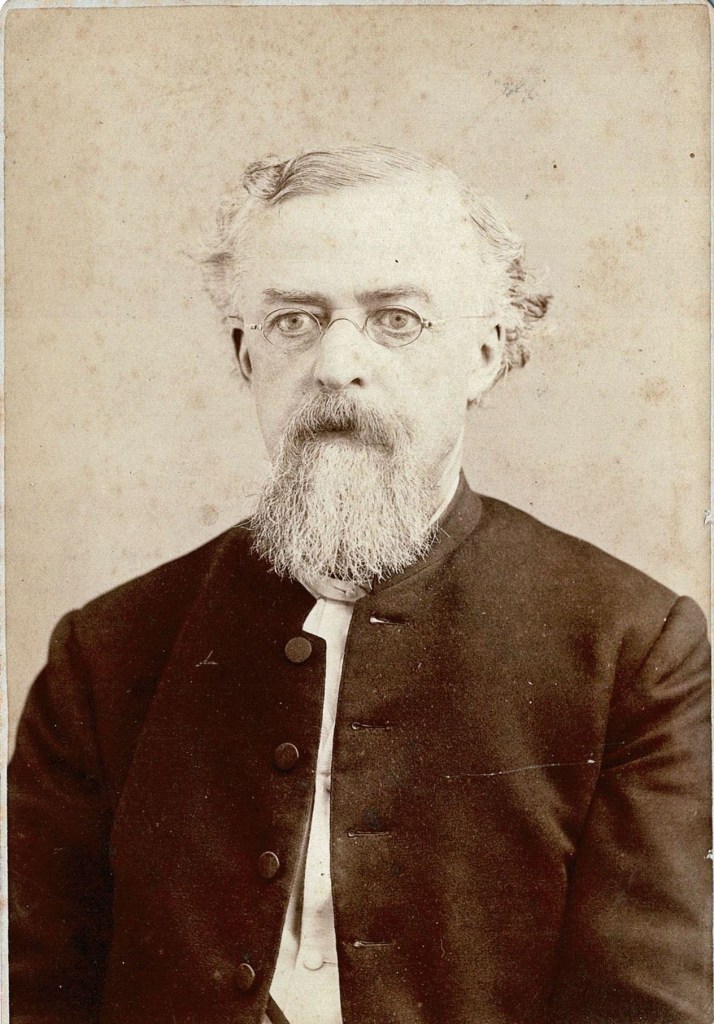
    Daniel Ferguson photographed by M. M.Hazeltine of Baker City about 1872

    I have written before about Daniel Howes Ferguson and his family. One post about a steamboat disaster on the Willamette River in Oregon, I called Too Much Fire in the Box. Before this Daniel joined the California Gold Rush in 1849. I wrote about this in a post called Traveling by Mailboat. Here are some other related posts.

    Places the Fergusons lived in include Norwalk and Danbury and in Connecticut. They also lived Yuba, California, Portland, Linn City and Baker City Oregon, the Cascades, Washington, and Lone Pine, California. Every time I open my research about the Fergusons, I wonder and theorized about his death and burial place.

    Why did he die in Maryland when he and Jeannette lived in the state of California? Where was he buried?

    Daniel Ferguson died rather suddenly near Washington DC. The Ferguson Family Bible reads, “Daniel H Ferguson died at Beltsville Station, Prince George County, State of Maryland on 28th day of September AD 1876, aged 60 years 6 months and 10 days”

    Upon Leaving The Cascades

    In my post titled Images, I described the Fergusons in Washington territory. They lived along the Columbia River in a town called the Cascades. Sometimes in the late 1860s the Fergusons left the Cascades.

    In 1868 Margaret’s older brother, James Ferguson, moved to Baker City and went into business with Margaret’s husband, Edwin Reynolds. They established a dry goods store in Baker City. James had been working in Eastern Washington in the Fort Colville area in his father’s shipping, selling and trading businesses.

    While living in Baker City James became acquainted with a young schoolteacher named Jennie Mann. In June of 1870, he married Jennie Mann of Barre, Vermont. This new couple moved into a house next door to Edwin and Margaret Ferguson Reynolds.

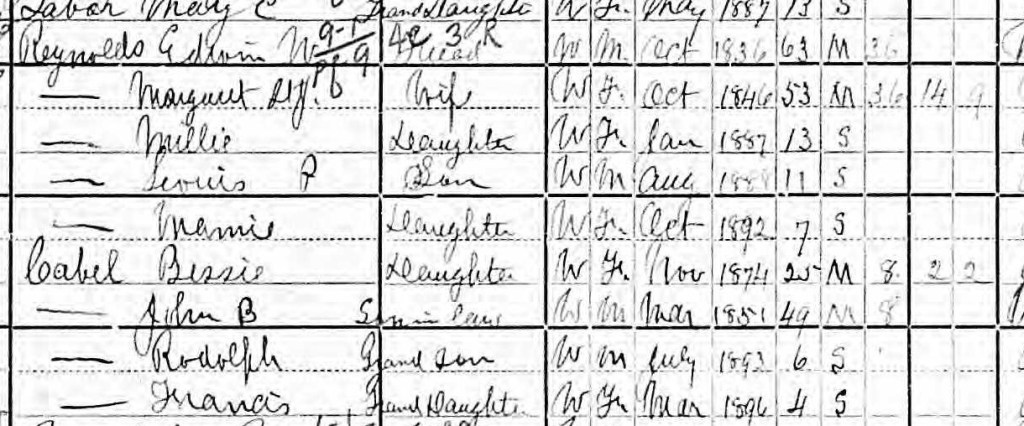
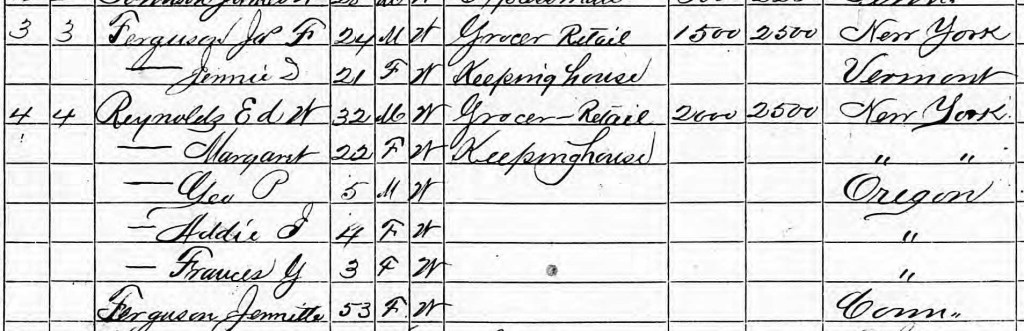
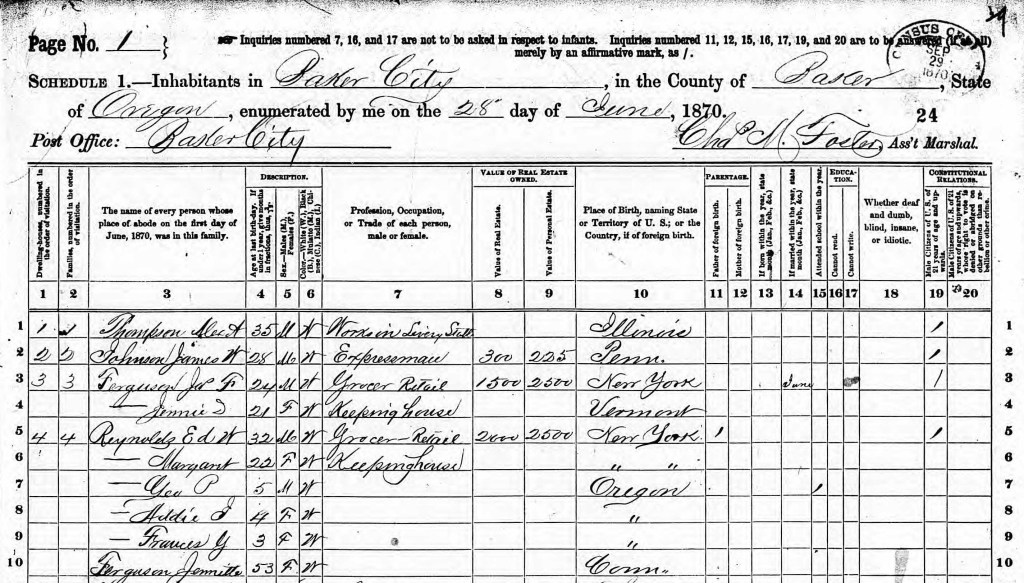
    The US census of 1870 for Baker City, Baker, Oregon, dwelling no. 3, family 3 lists James F. Ferguson, age 24, occupation, retail grocer, real estate value, $1500, personal property, $2000, born in New York.  Listed next is Jennie Ferguson, age, 21, occupation, keeping house, born in Vermont.

    The next entry, dwelling no. 4, family no. 4 is for Edwin W Reynolds and his family. Margaret Ferguson Reynolds, age 22, occupation, keeping house, born in New York is listed next. The three children were George, Addie and Frances, all born in Oregon. Lastly, Jeannette Ferguson, age 53, born in Connecticut is listed. Some of the names are spelled wrong.

    Here is an image of this June 28 1870 Federal Census record for Baker City, Baker, Oregon

    In June of 1870, Federal Census records placed Daniel Ferguson in Cerro Gordo, Inyo, California. Daniel, head of family no. 18, owned $300 in real estate and $3000 in personal property. His occupation was listed as “teamster” as were the other two men who were Omie Mair and Edward Foster. Here is an image.

    Cerro Gordo, California

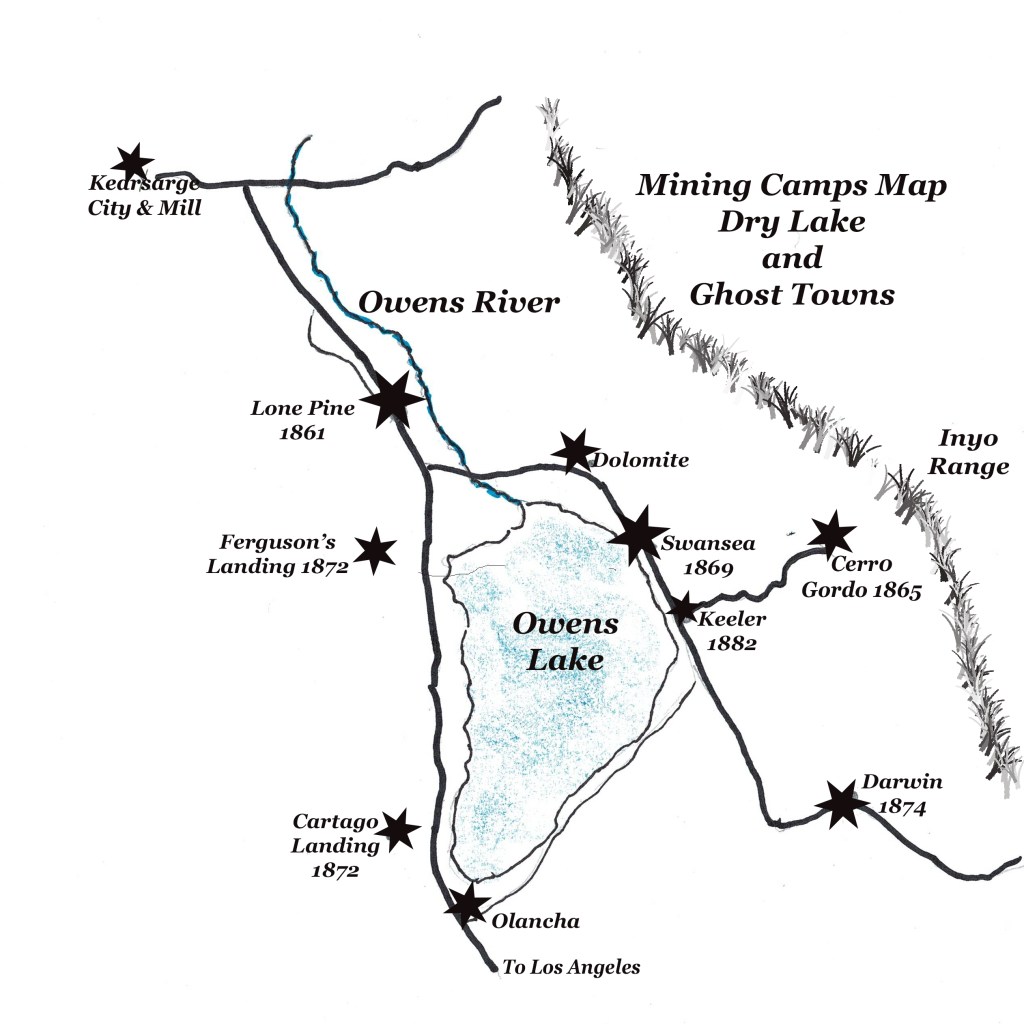
    Cerro Gordo Spanish “Fat Hill” was the name of a mountain in the Inyo range. Daniel was here in the mining camp called Cerro Gordo. This mountain, located near Death Valley, is about eight miles east and 5,000 feet above Owens Lake. Other mining communities in this area were Dolomite, Swansea, Keeler, Olancha and Cartago. These camps were located along the shoreline of Owens Lake. In 1872 there was even a place called Ferguson’s Landing on Owens Lake. Today the lake is dry and the towns are ghost towns. Here is a map.

    Map based on map found in digital-desert.ca

    Getting the Ore from the mine to Los Angeles

    The first transcontinental railroad was completed in 1869 and there were short line railroads in many western towns. This was not the case for the Cerro Gordo mines. Transport was by mules pulling wagons.These wagons loaded with silver and lead traveled more than 200 miles. It was that far from the Cerro Gordo mines to the ports and markets of Los Angeles. On the return trip the wagons carried supplies for the miners. The miners needed clothing, building materials, utensils, dishes, tools, tack, canned goods, flour, sugar, coffee, liquor and other goods. The drivers of these wagons were called teamsters.

    An estimated 17 million dollars’ worth of silver and lead arrived in Los Angeles from these mountain mines. Residents of Los Angeles credit these mines for the size of their city. They say it would not have become the large bustling port town it was in the late 1800s. It would not be the big city it is now.

    In the early 1870s Daniel’s wife, Jeannette and son, James joined Daniel in Southern California at Lone Pine.  Jeannette’s relatives In Connecticut wrote to Jeannette in Lone Pine, Inyo, California in 1873.

    During the 1870s Lone Pine was an important supply town for Kearsarge, Cerro Gordo, Keeler, Swansea and Darwin. Lone Pine was about 5 miles from Ferguson’s Landing and 12 miles from Cerro Gordo.

    The Building of the Bessie Brady

    Starting in June 1872 the Bessie Brady, hauled ore milled into ingots at Swansea across the lake. Before this the 85-pound silver-lead ingots had to be hauled by mule and wagons around Owens Lake.

    In 1872 a shortcut across Owens Lake was orchestrated by James Brady and Daniel Ferguson. I found a credible reference for this partnership. The Los Angeles Department of Water and Power had this to say.

    So much silver was extracted that a small steamer, the Bessie Brady, was built in 1872 by James Brady and D.H. Ferguson. (Its purpose) was to ferry the bullion across Owens Lake from Swansea to Cartago Landing, thereby reducing reliance on mule transport.
    Los Angeles Department of Water and Power ,https://www.lawp.com, page 30

    This saved time and money on the 200-mile trek to the ports of Los Angeles. The building of the Bessie Brady involved both men’s time, money, and experience. D. H. Ferguson had knowledge of steamboats and how to build them. My theory is that Daniel’s experience building the ill fated Gazelle, guided much of this project.

    Another project Daniel did in 1872 was acquiring a plot of land at the northwest corner of Owens Lake. He built a wharf there and called it Ferguson’s Landing. The daughter of James Brady, Bessie Brady, christened these men’s boat at Ferguson’s Landing on July 4, 1872.

    After the Bessie Brady was built, she was moored at Swansea. She crossed Owens Lake to both Ferguson’s Landing and Cartago Landing carrying silver-lead ingots.

    This article called “Naming of the Bessie Brady”, provides details about what Daniel and James had been doing. It describes an interesting day in the life of some 1870ers.

    Naming of the Bessie Brady


    By 1872 Cerro Gordo’s bullion output was large. The mode of moving it to tidewater at Santa Monica or San Pedro was by teams, under a general contract. Later this method was brought to precise system; but at that period, it was both unsatisfactory and inadequate. Many tons of bullion were usually pulled up near Owens Lake from the furnaces at Cerro Gordo and at Swansea, awaiting moving. Hauling around the lake was slow and expensive; it takes a twelve-animal team five days to go from Swansea to the foot of the lake…hauling but six tons a load. The need of improvement caused Superintendent James Brady of the Owens Lake Silver-Lead Co and D. H. Ferguson to decide to build a boat. It was constructed in the spring of 1872, at a cost of $10,000. Its dimensions were 85 feet keel, 16 feet beam, 6 feet depth of hold, with a 20-horsepower engine. A 52-inch propeller drove it and with light draft part of the propeller was always out of the water. Though not large the boat was a big step ahead in facilities, for it was able to make a round trip daily from Swansea, at the lake’s northeastern curve to Cartage at the southwest carrying 70 tons of freight. A comparison with the teaming time and capacity already mentioned is of interest. For nearly ten years, until the coming of the Carson & Colorado railroad caused the Cerro Gordo Freighting Company to quit this field, the boat was a money- saving factor in the valley shipments, both ways for the mines and the valley.
    On the Fourth of July 1872, the valley’s chief celebration centered around the christening of the little ship. Twenty carriage loads of people and many horsemen from Independence and Lone Pine and the country between, left Lone Pin that mourning and traveled the five miles to Ferguson’s Landing before the boat, coming across from Swansea, arrived towing a barge to serve as a temporary wharf. A hundred and thirty excursionists embarked. The little Bessie, daughter of Superintendent Brady, stepped to the bow of the boat and broke a bottle of wine on it, lisping "Bessie Brady”. W. H. Creighton, a citizen with poetic aspirations, read an “Ode to the Bessie Brady”.
    The first steamer excursion on the lake made its way to the lower end. With the seven-mile speed, the unclouded July sun overhead, an open deck, the reflecting water around and the heat of an unhoused engine to add to its might, it may be supposed that some degree of enthusiasm was required to enjoy the dancing which went on until the perspiring excursionists reached the mouth of Olancho Creek. Disembarking there, the party picnicked, listened to the Declaration of Independence and otherwise spent the time until evening coolness came, and a delightful return journey became possible. The festivities ended at Lone Pine.
    The Silver-Lead Company built a 300-foot wharf at Swansea and others were put up at Cartage and Ferguson’s landing. The lake was then supposed to be unfathomable; but its very gradual deepening made light draft a necessity in the boat. Good water was obtained on the eastern side by boxing an underwater spring so that its water rose several feet above the lake level for the steamer’s use.
    “Naming of the Bessie Brady”, Inyo Independent (Inyo), 29 Sept 1916, Vol.47 No. 21, California Digital Newspaper Collection, archived (http://cdnc.ucr.edu)

    In September of 1872 James Brady sold his interest in the Bessie Brady to John Daneri and Daniel Ferguson. Unfortunately, in 1875 their steamboat company folded and Casper Titchworth purchased Ferguson’s interest in the Bessie Brady.

    Questions and Theories

    Here are my theories about Daniel and Jeannette’s travels to the east coast in 1876.

    Daniel and Jeannette decided to go back east as far as Washington, D.C. Daniel’s mother Fanny Ferguson died in Davenport, Scott County, Iowa on April 30, 1876. I hope he saw her before she died.

    Fanny had moved to Davenport sometime after 1880; her youngest child, Fannie A. Ferguson Stewart and her husband Jacob Stewart lived in Davenport.  The old blue scrapbook held two photos of Aunt Fannie, one taken in Davenport around 1880.

    Daniel Ferguson died near Washington D.C. The Ferguson Family bible gave the date as September 28, 1876,in Maryland.

    After

    After Daniel died, Jeannette did not return to the West directly. Instead she stayed with her brother and sister-in-law. In 1880, she was found in the household of her older brother Albert Keeler and his wife Harriet. They lived in Yonkers, New York. Here is a image of the 1880 U.S. census record for Albert and Harriet Keeler ling in Yonkers,Westchester, New York. Jeannette Ferguson, age 65, is listed as a boarder.

    She died in Baker City, Oregon on April 19, 1894. Family buried her in Mount Hope Cemetery in an unmarked grave next to her daughter-in-law, Jennie Ferguson. Her obituary reads:

    Last Friday’s Oregonian noted the death on the day previous of one of the pioneer women of the state at Baker City,” Mrs. Jeanette Ferguson, aged 79 years, widow of the late D. H. Ferguson, a well-known pioneer of 1853, died of cancer and paralysis. She was born in Danbury, Con., on April 10, 1816, and resided in Oregon City, Or., in 1853.” In the early times before the great flood of 1861 her husband was a prominent businessman and mill owner at this place. When Linn City was flourishing, he was the principal mill owner at that place and many of the old timers remember well both him and his wife. Mrs. Ferguson was a grandmother of Mrs. E. M. Mack (Addie Ferguson) of this city. 
    “Chat About Town”, Oregon City Enterprise (Oregon City), April 27, 1894, Image 3, Col. 3, digital images, Historic Oregon Newspapers,(http://oregonnews.edu accessed: April 23,2015)

    Daniel and Jeannette Ferguson were Oregon pioneers, adventurers, parents, and unassuming people. Jeannette was buried in an unmarked grave in Baker City, and we don’t know where Daniel was buried.

    Certainly, Daniel Howes Ferguson embodies the definition of an entrepreneur. A definition reads“a person who organizes and operates a business taking on greater than normal financial risk ”.  In his sixty years of life, Daniel did this many times. His freighting and trading activities coupled with his inventiveness made life in the American frontier easier.

  • Albert Lonski Wartime

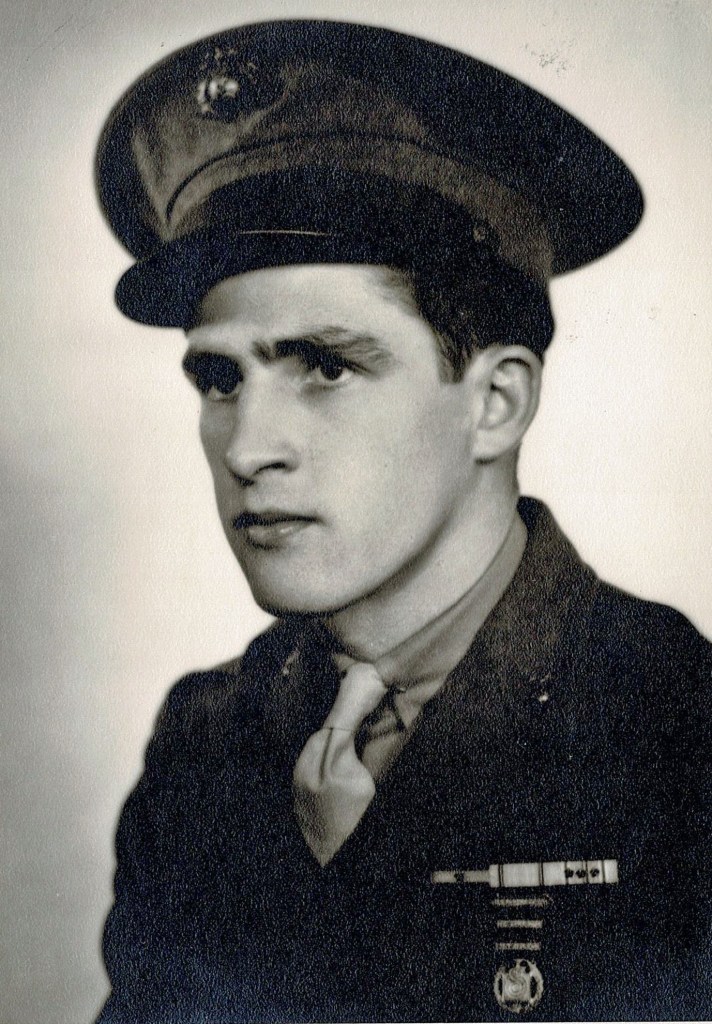
    My father, Albert Thomas Lonski, wore his dress uniform for this portrait photograph. This uniform, his dress uniform, included a forest green coat, trousers of the same color, a khaki shirt, and tie. The insignia on his hat and lapel was the Eagle, Globe and Anchor (EGA). This was Marine Corps symbol.  The next photo shows his Service ribbon bar at the top. This bar is divided into 3 parts. The Presidential Unit Citation on the left was awarded to all the men in his unit for heroism in action. His unit was Headquarters and Service company, !8th Marines. He was in the mapping section. In the center, the American Defense Service medal is represented. Military service members who served on active duty between 8 Sep 1939 and 6 Dec 1941 got this medal. In the right section is the Asiatic-Pacific Campaign Medal. It went to those who served in that area from 1941 to 1945. Albert had 3 service stars on this right side of his service bar. These stars were often called battle stars because they meant that he participated in a named campaign.

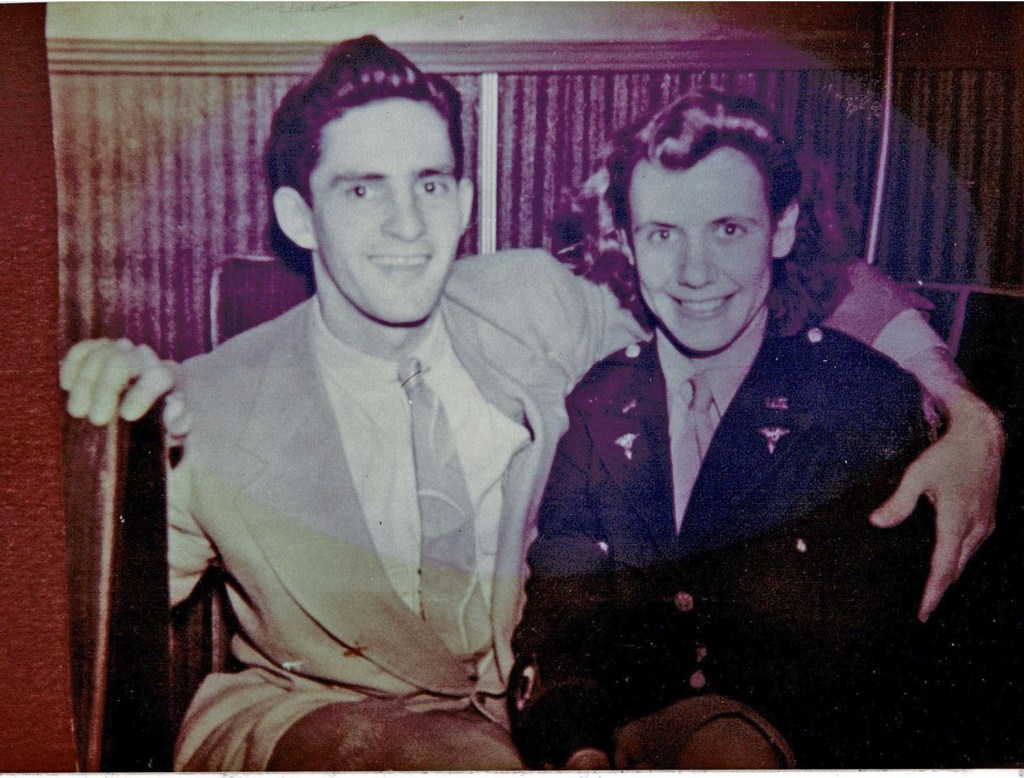
    Albert’s sweetheart, Helen Wolfe, also served during WW2 in Normandy, France. Toward the end of her life she wrote her story of day  of Victory in Europe.

    She, an army nurse, was my mother. In this piece she reacts to the news the war has ended. She heard it as “La Guerre est finie.”

    “La Guerre est finie” boomed the French voice from the radio shattering the darkness.
    I stood alone and listened. I was caring for a large ward of wounded soldiers. It was midnight in France in 1945 (May 8). To all of us this meant we could go home again to our own families and our country.
    I asked myself should I wake my soldiers and tell them. I didn’t, saying to myself what if it is a false report as it might be? For days the two armies faced each other in the valley. This meant that the Germans had finally surrendered the command to the Americans. It was very dramatic standing in that darkened room hearing the war was at last over. The radio became lively with chatter spoken in excited German voices. I spoke a little (German) and could make out only a little bit. I did understand that Hitler married his sweetheart, Eva Braun, then both committed suicides.
    I stood alone in the dark talking to myself with world shaking news leaking around me. Oh, why didn’t I wake up some of my soldiers? I didn’t. I did go to my night supper where all on duty went for a meal. There I got to share and say, “La Guerre est finie”. Most of them had not heard.
    How different was the next night! I left the radio on for all the soldiers to hear a discussion about the GI bill. This bill would make a difference in the lives of these young men. They could go home, marry their sweethearts, have babies and go to school (with the help of this GI bill). It was a wonderful investment in people. Our government’s G I bill would make a difference to each of us and we were grateful and ready.
    The next week I received five proposals of marriage. These soldiers were ready to start a family and start living.
    I had a recent quarrel with my Albert, but he still held my heart. I accepted one of the offers, knowing I would not keep it. I, too, wanted to go to school.
    Instead, we married as soon as we saw one another.
    Eventually, we had two beautiful daughters (their oldest one being born almost exactly 9 months after they married). There was enough to do. We used the GI benefits and felt so rich with the 90 dollars the government gave us to live on. We soon had everything. We had two lovely children and enough to eat and La Guerre est finie, no more war.
    We lived in my mother’s old house in Oregon. Albert remade it into a beautiful palace covered with stones he carried from the rock quarry (also on his mother-in-law’s property).
    Our daughters grew daily.
    Next part -Albert’s career
    After years (of higher education), Albert was tired of college. He contributed (his skills) to making airplanes. He helped develop the 747. We moved around the country a lot with him working for Boeing. He helped get the Saturn Booster in the air.
    It all ended (when Albert retired). We went back to our stone castle on the river. By that time we had four beautiful grandkids. What treasures they were and still are.
    Now our country is in a miserable war (Iraq War) which they cannot win. I hope these soldiers can come home and be ordinary people again. Then perhaps la Guerre est finie can happen.

    Albert Lonski Goes to War

    Early life

    Albert Thomas Lonski arrived in this world on February 6, 1922, In Bremerton, Washington, USA. This was the same year Hitler formed Jugenbund, predecessor to the Hitler Youth organization in Germany. Albert’s mother, Anna Luise Taubert, was born in central Germany. She came to North America as a young woman. Her brother, Walter Taubert, kept in contact with her and her family. He sent birthday cards to his nephew, Albert. Here is a photo of the postcard Albert received on January 21, 1933. Walter’s son, Helmut, who was Albert’s first cousin, wrote out the message. “Greetings to you, from your Helmet, Parents and Grandparents”. The grandparent would have been Luise’s mother who was also the grandmother of Albert.

    This same Helmut joined the German army when grown. He likely belonged to Hitler Youth as a teenager.

    When Albert was only 16, when he graduated from Franklin High School. Then in December of 1938, wanted to join the US Marine Corps. Young men were allowed to join at age 17 if they had written parental consent. It was likely Albert’s father, Thomas Lonski, who gave this consent. This must have been a difficult time in the Lonski household. Seventeen days after his 17th birthday on February 23,1939 Albert did join.

    In the Marine Reserves

    According to the Marine Muster Rolls from the National Archives, Albert drilled at the Canadian National Dock in Seattle. Dates included were March 1, 8, 15, 23, and 29.

    On December 20, 1939, he qualified as an Expert Rifleman.

    Albert’s unit, the second Division Combat Engineer Battalion, was activated on November 1, 1940, in San Diego, California. Albert stayed in Seattle, but drilled with his reserve unit at Aberdeen, Washington.

    Out of the Reserves into Training- Camp Elliott

    Pearl Harbor Attack occurred on December 7, 1941

    Albert went to Camp Elliott before the Pearl Harbor attack. He trained at this camp in San Diego and is here in April 1941.  Second Lieutenant, Ben Webtherwax, led class 2. Albert was a topographer. On the October muster roll he was also a topographer.

    Still at Fort Elliott in January 1942, Albert was then a private 1st class working in the mapping section.

    Camp Dunlap, Miland, California

    By July of 1942, Albert trained in a California desert camp, Camp Dunlap. Here he met Helen Wolfe, a nurse working at Brawley Hospital. Three liberty passes for Albert have the wrong birth date typed at the top. This made him seem two years older than he was. Helen was 24 when they met; Albert was 20. When Albert showed Helen his liberty pass, she thought he was 22. Of course, the truth came much later and she was mad.

    His October 1942 Muster Roll read,” Albert Lonski, computer, mapping section”.

    New Zealand

    In 1942 and 1943 New Zealanders in Wellington shared their space with 15,000 young American Marines. The U.S. Marine corps used Wellington, New Zealand as a base for training and staging during WW 2. It was also a place for soldiers to rest and recover from being in the field.

     Albert with the 2nd Marine Division arrived in January 1943. His unit was stationed at Camp McKay. Albert took photos. Few had written descriptions; many were stamped on the back with this mark.

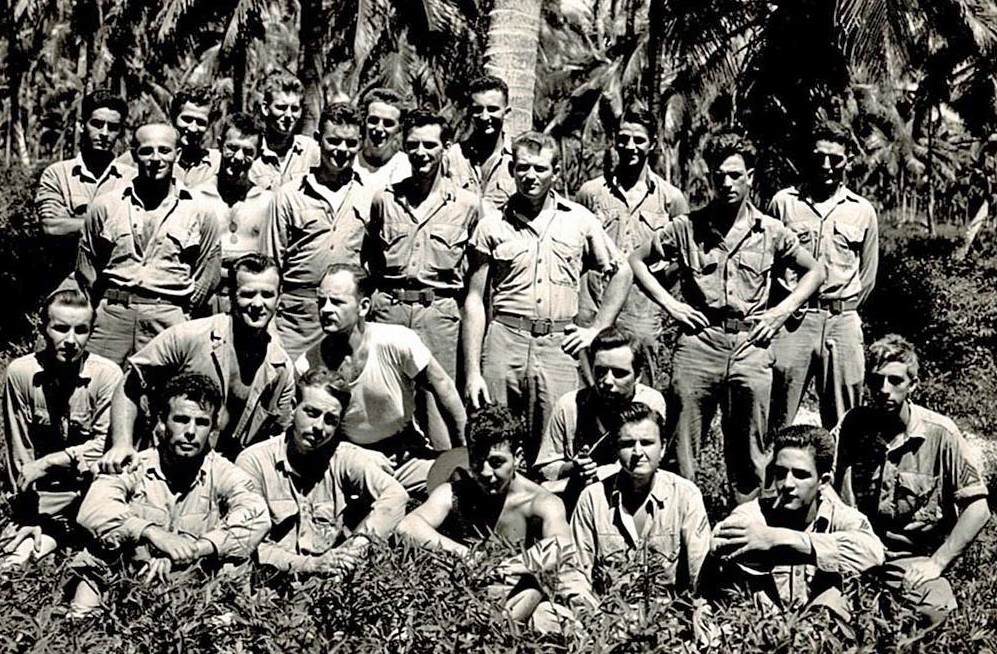
    Here is a group photo of his unit in New Zealand. He is in front on the right. This is written on the back, “March 29, 1943, after 3 months.” Albert is in the front on the right.

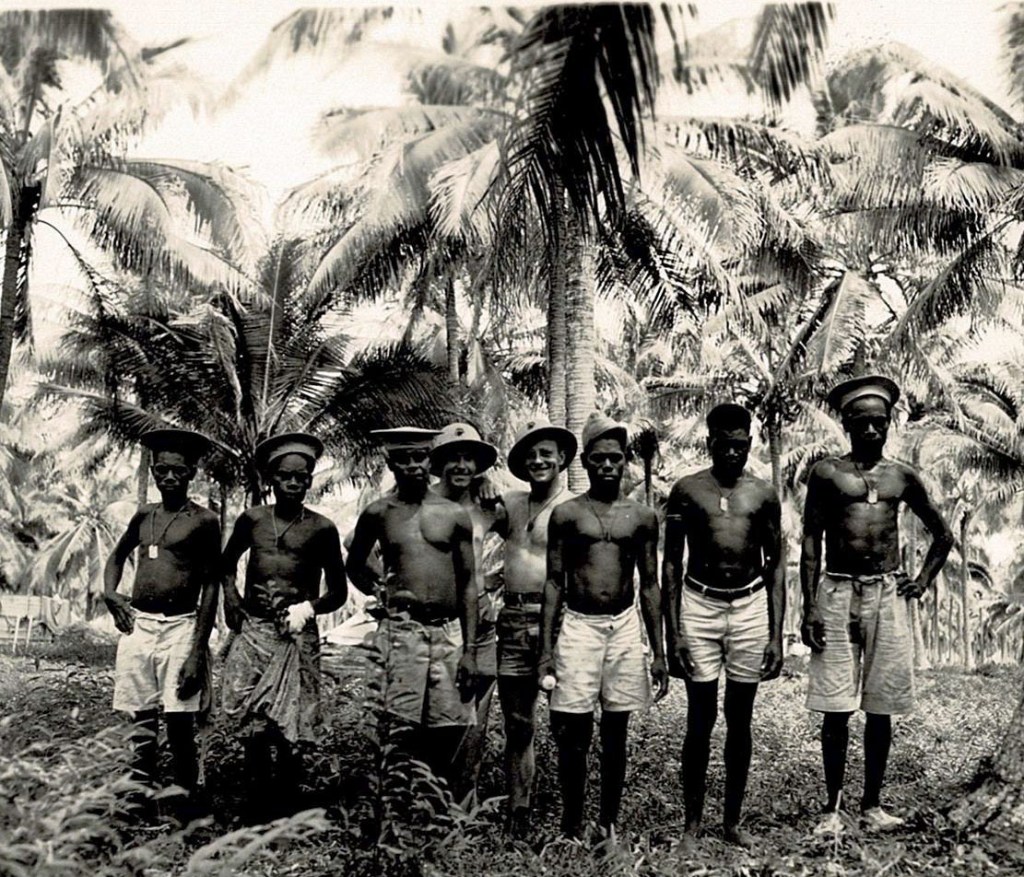
    He photographed more than a few natives while in New Zealand.

    More photos

    In the Field

    His first stay here was brief. He left on December 12, 1942 aboard the USS Bellatrix. He wore the 3 stripes of a technical sergeant on his sleeve. The Marine Muster Rolls don’t say where he went, just that he went to sea and was in the field.

    Campaigns

    On September 8, 1942, headquarters changed Albert’s Division to the first H&S co., 18th Marine (engineer), 2nd Marine Division. H & S stood for Headquarters and Service.

    The engineers of the 18th took part in campaigns in Guadalcanal, Tarawa, Saipan, Tinian and Okinawa. According to his discharge papers, Albert “participated in action against the enemy”. He was at the Battle of Saipan of the Marianas Islands from 16 June 1944 to 9 July 1944”.

    Saipan

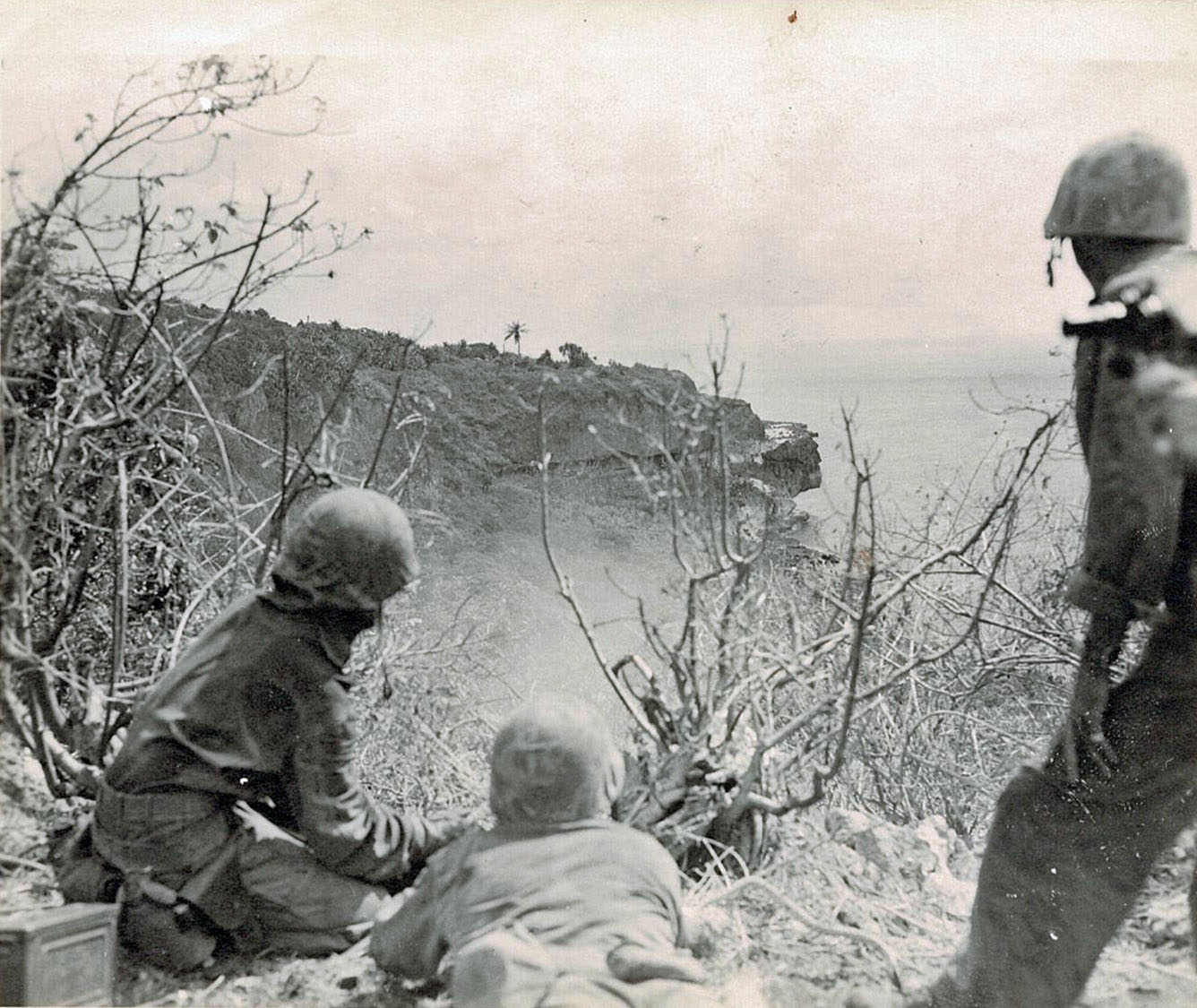
    Before Japan attacked the fleet at Pearl Harbor on December 7, 1941, crippling the fleet, Saipan was a farming community. After Japan took formal control of Saipan in 1919, large sugar cane plantations were planted there. Warm, humid air, year-round rain and much sun made the land lush with plants. The terrain was mountainous. Cliffs and gullies dotted the landscape. There were many dark caves and swarms of mosquitoes. Malaria was a problem.

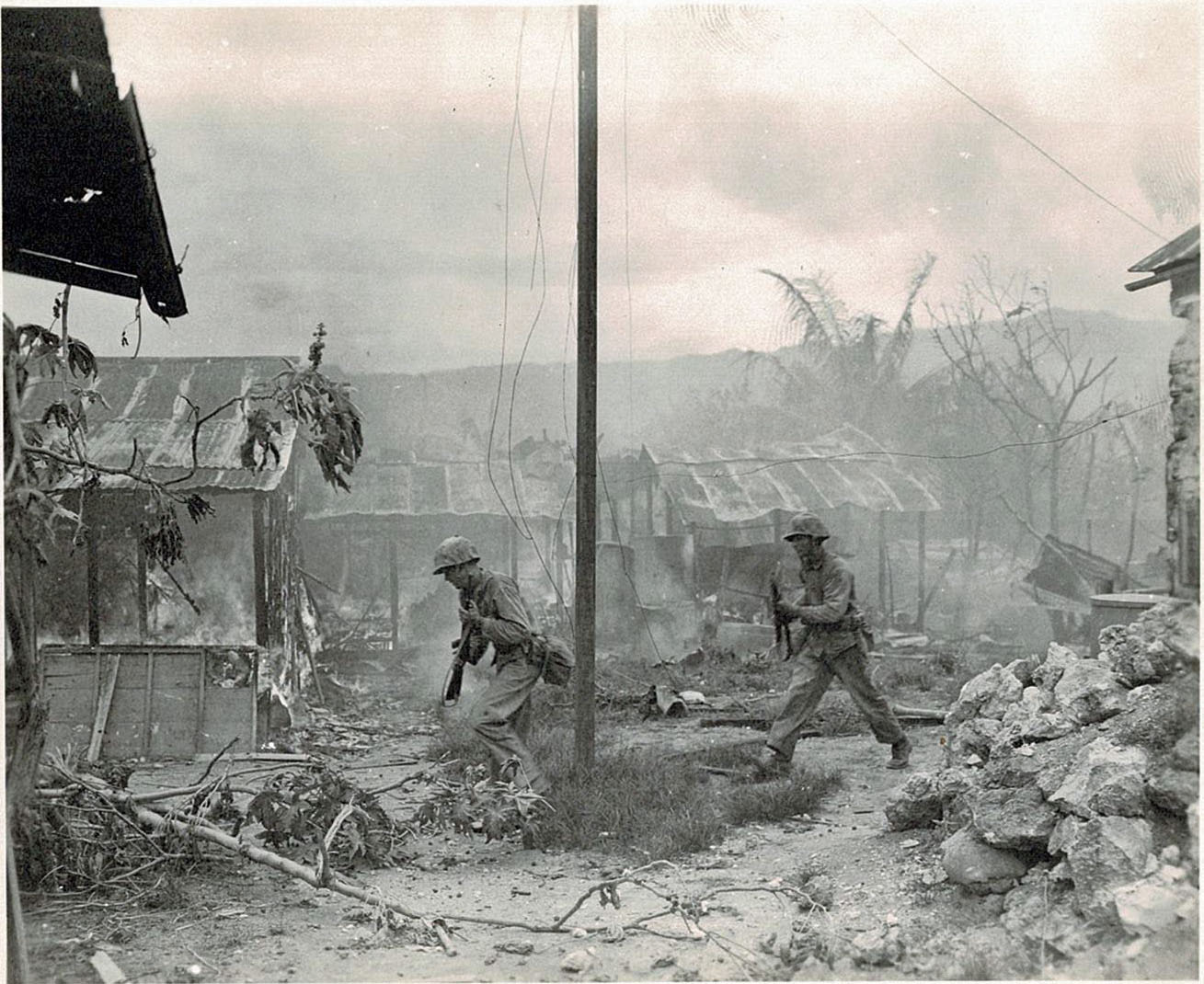
    Months before the U.S. Army, Marines and Navy attacked on June 15, 1944, the Japanese had fortified the island with extra troops. Many of the civilians’ homes were confiscated for military housing. People were forced to live in caves.

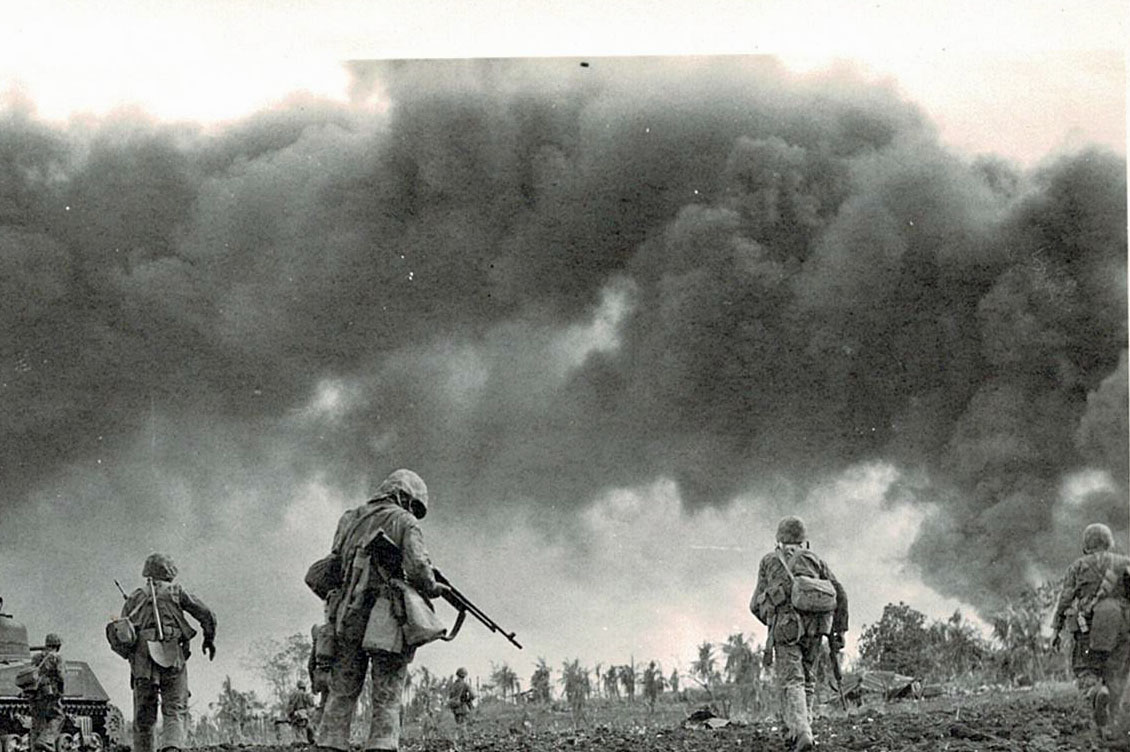
    War raged in Saipan from June 15 to July 9, 1944. These are the dates on Albert’s separation papers that he fought there. About 3,426 Americans were killed. Japan lost 24,000 soldiers and 22,000 civilians were also lost. Many of these civilians committed suicide; some were shot by their own soldiers.

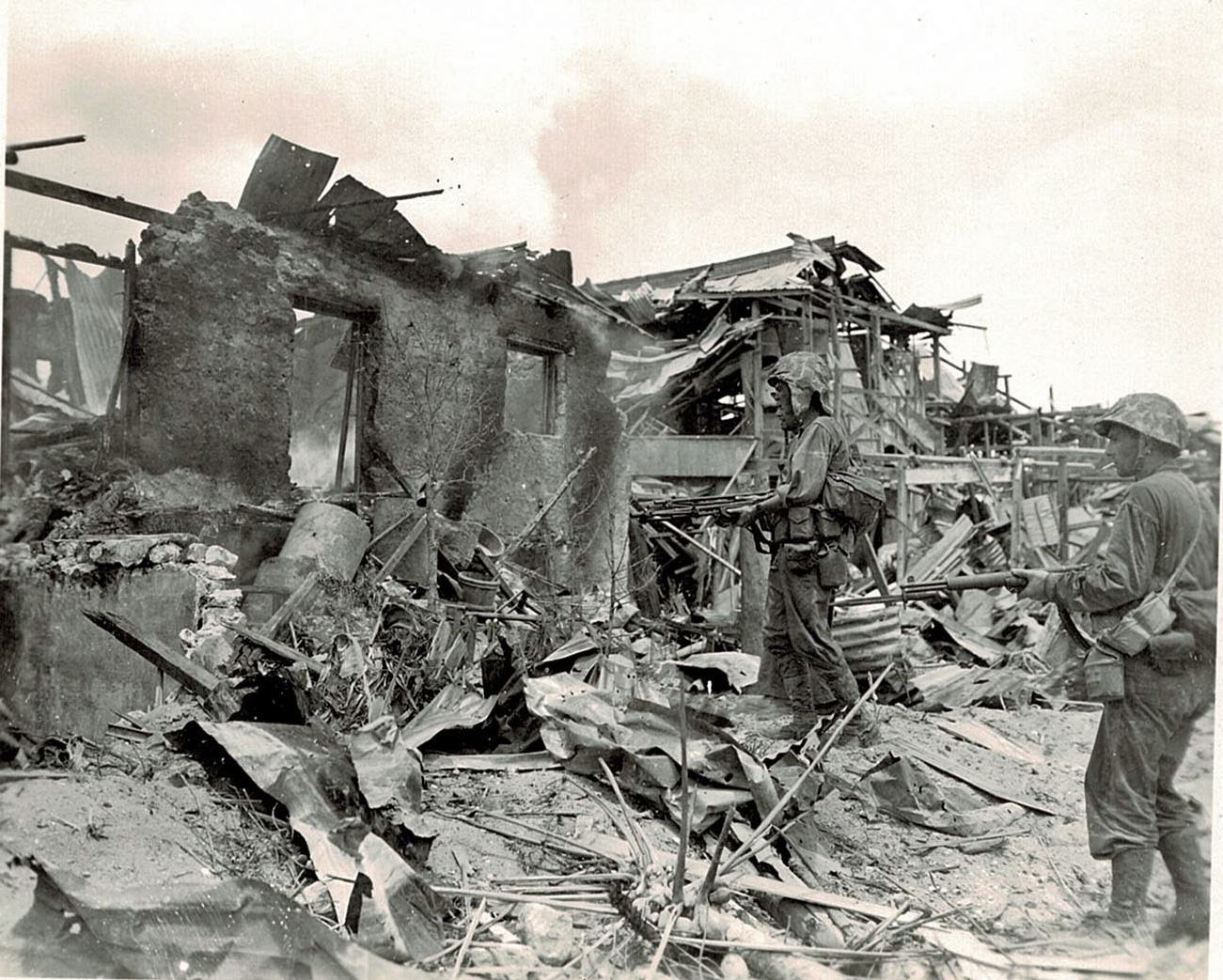
    Before this battle Albert had been temporarily attached to the 2nd Division Marine Fleet. He was then with the Amphibians Corps. The first day of the Battle of Saipan saw a fight between American amphibious tanks and Japanese tanks. At the end of the first day most of these vehicles had been damaged beyond repair. Most were put out of commission by soldiers in fox holes.

    Albert, a phototopographer in the mapping section and a technical sergeant, never mentioned his fighting days in Saipan. What he did talk about was his surveying and mapping of Saipan. A phototopographer surveys and maps a terrain based on territorial photographs. The navel construction battalions, the Seabees, built the Navel Advance Base, Kogman Point Airfield and Isley Field on Saipan. Airbases on these islands were critical to winning the war in the Pacific.

    There is a documentary online from Real Time History called Saipan 1944 Total War in the Pacific. Here is a link to Total War.

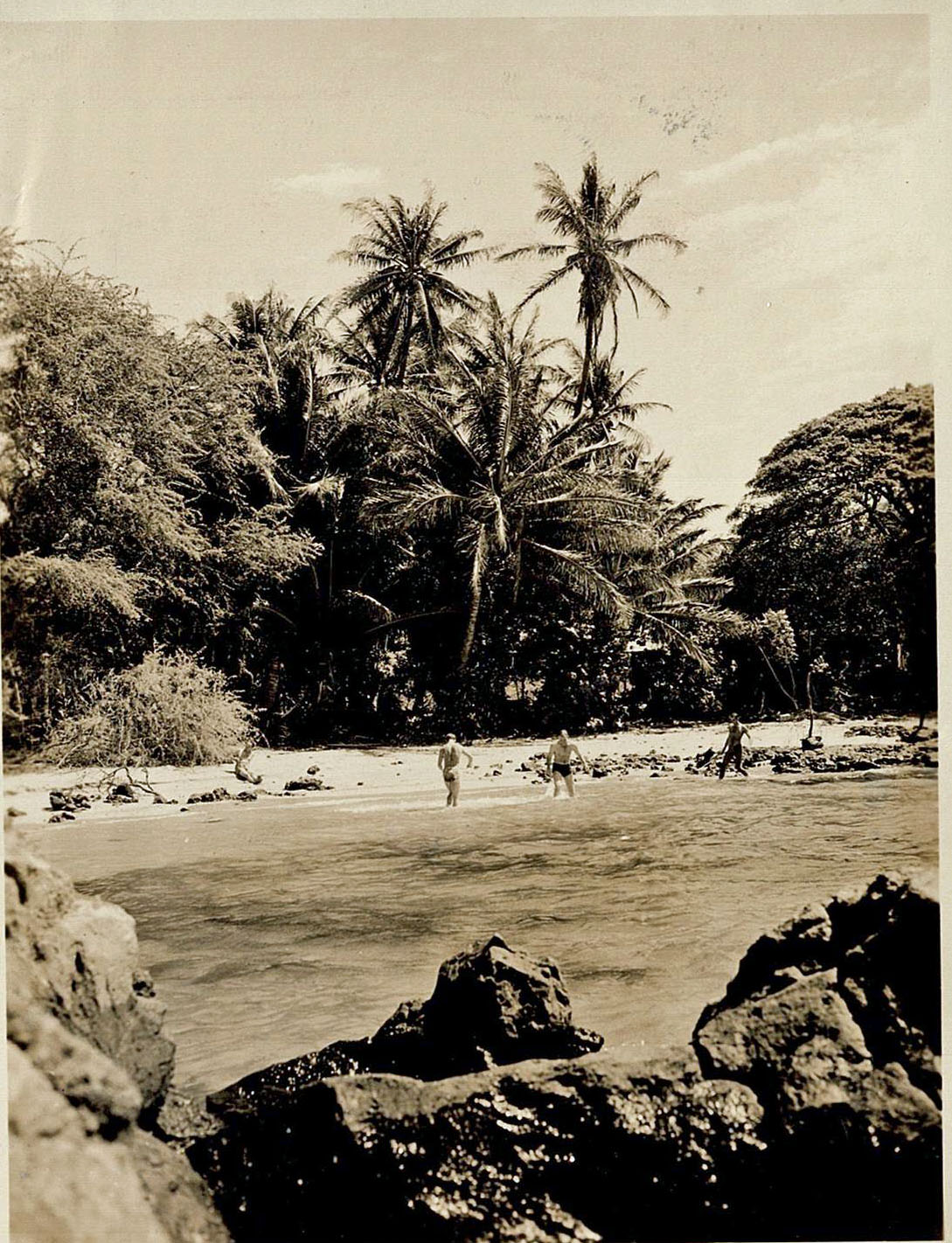
    Albert took photos.

    Going Home

    By September 1945, Albert back in the United States, was assigned to Camp Lejeune, North Carolina .Albert had been assigned to active duty on November 7, 1940. He received his Honorable Discharge Button at Camp Lejeune, North Carolina on September 20, 1945. The Marine Corps also gave him a travel allowance of 5 cents per mile to get home to Seattle, Washington.

    In Albert’s collection of photos from his service days, I found a photo that touched me. An Asian child, barefoot and beautiful, leans against a dead snag on a deserted beach. The sun is shining as shown by the sharp dark shadows behind the snag.

    I don’t know if the photo is posed or is something Albert just happened across.

    I do know I felt achingly sad, looking at it.

    What was Albert doing here? He had become an engineer. Engineers like to build things.

  • Written

    Week 49 -Written- Helen Wolfe Lonski (my mother)

    Well-chosen words, piles of poems, long letters to the editor of the local newspaper and stories scribbled on scraps of paper abounded. Helen Margaret Wolfe Lonski left these items in my care. That was a lot of written words to go through. She knew written words caused conflict.

    She wrote these two short poems about the responsibility people had to use words wisely.

    Responsibility One

    Every time your tongue’s unkind
    Something dies
    In another soul.
    If to healing words
    Voice is given
    Something shriveled
    Comes alive
    In another being.

    Responsibility Two

    Words wound,
    Words mend,
    Words hurt,
    Words heal.

    Even as a young child stories, books and words fascinated her. Growing up on a hop farm in Brownsville, Oregon. She did chores. She wrote about one chore she really liked.

    One of the fun jobs we had was keeping the cows out of the corn patch that grew in their grazing ground. Mother gave us a blanket and books. She packed us a good lunch in a basket. I got two shining dimes a day for my labor. The older children got more. How rich I felt with two small silver pieces.  One thousand dollars could not have been as much. When I saved $2.00 in dimes I took my family to the ice cream parlor for a treat. That store is still in Brownsville with its old crooked planked floor.

    Then Helen’s family consisted of her father, Bert Wolfe and her mother Edna Olsen Wolfe. Her two older siblings were Harry and Mildred.

    Helen had been born on December 26, 1917. Then the Wolfes lived on Bert’s hop farm near Independence, Oregon. They moved to Brownsville in 1920 where Bert established a new hop farm. Helen didn’t remember the Independence farm.

    One of Helen’ early memories was the sad one. The family buried Helen’s father, Bert Wolfe in the Brownsville Pioneer Cemetery in November of 1925. Helen wrote a poem about this. She called it,

    To A Father Asleep

    They told me Time would heal the wound
    That passing years would leave the mark
    Only Of a vague pain of thy gentle memory.
    They lied. I felt then only numbness and a strange awe
    That grownups usually indifferent, were suddenly kind.
    Taking us three children by the hand
    My aunt led us
    For one last look at your dear face.
    It seemed you were quietly sleeping.
    If I could but touch your hand
    I longed to tell you
    Of the letter that had come for you that day,
    The sadness of the dog, Laddie, since you went away,
    But the urgent pressure on my shoulder restrained me.
    My aunt spoke slowly
    "Your father was a man greatly beloved."
    She motioned toward a bank of flowers
    Making the air heavy with their perfume,
    White Lilies, gorgeous hot house flowers.
    I missed the honest gleam of buttercups,
    The homely glow of dandelions.
    Flowers that you had graciously accepted
    From small sticky fingers.
    Helen favorite grown up woman was the aunt in this poem who spoke slowly and held her hand. Helen wanted to be like this aunt, her mother’s only sister, Sigrid Olsen.  Sigrid received her nursing diploma from the College of Medical Evangelists at White Memorial School of Nursing in 1920. Helen Wolfe received hers from the  same nursing program in October of 1941. While Helen studied at Loma Linda campus in California, she happily wrote this poem.

    Laughter

    	Laughter is an elusive thing,
    As hard to hold as quicksilver,
    Bright, flashing through your fingers.
    Glinting from many friendly voices
    As sunbeams on granite cliffs,
    And sparkling out from happy days
    As moon light on moving waters.

    At White Memorial Hospital

    Here is a photo of her dressed in white to view a surgery.

    After a year of book studies at Loma Linda, Helen went to Los Angeles. She was a student nurse at White Memorial Hospital. While there, she did rotations. She didn’t like all the rounds as she implies in the next poem.

    L.A. County General, Hospital Before Antibiotics

    It seemed to me
    As up and down we walked
    These contaminated halls,
    That little bugs crawled in and out,
    And over all the walls.
    The floor it moved beneath our feet
    Almost of its own accord.
    Dread diplococcus and sporocysts
    Swat lustily aboard.
    The kids all yelled with a hearty will
    And resisted nose drops mightily.
    Vexed and perplexed, I endeavored to quell
    The noise that eddied around me.
    As I soothed their unhappy little noses
    Bathed their bodies, and changed their beds
    Life was full of big red roses,
    Howling kids, and 'coughs, and sneezes.
    Sorry, I regretted choosing nursing,
    When I landed on contagious diseases.

    Helen graduated from White Memorial School of Nursing on October 1, 1941. She received a certificate from the California Board of Nurses Examiners stating she was a registered nurse.

    Brawley

    At the end of her nurse’s training, she went to work at a 6-bed hospital in Brawley. This private hospital served the Brawley Community in the 1930s and 1940s. In 1950, the larger Pioneers Memorial Hospital opened in Brawley.

    Helen received a letter from the California State Nurse’s Association. The postmark reads Brawley, California, 30 Sep 1942. The 610 Imperial Ave. address matches that of the Brawley Hospital.

     It was here that she met Albert. Before they dated each other they dated mutual friends. Albert Lonski did his basic training at Camp Elliott, near San Diego.  He, a marine sergeant, shipped out in November of 1942. Camp Elliott trained Marine recruits for the South Pacific.

    The Colorado Desert, Brawley’s location, had a tropical climate. Albert wrote to Helen. She answered in kind, and they exchanged letters throughout the war.

    Helen wrote this poem.

    Desert Night East of L.A.,California

    We see
    Night light soft and dim,
    On the white of the yuccas,
    Ten million bright stars,
    A round full moon
    Tangled in the tall pines.
    We hear
    The tiny tinkle of a small brook.
    The hillside holds its breath
    We dare not speak

    left, Albert and Helen in Brawley—-right, Albert’s wallet photo of Helen

    From Albert Stationed in the South Pacific

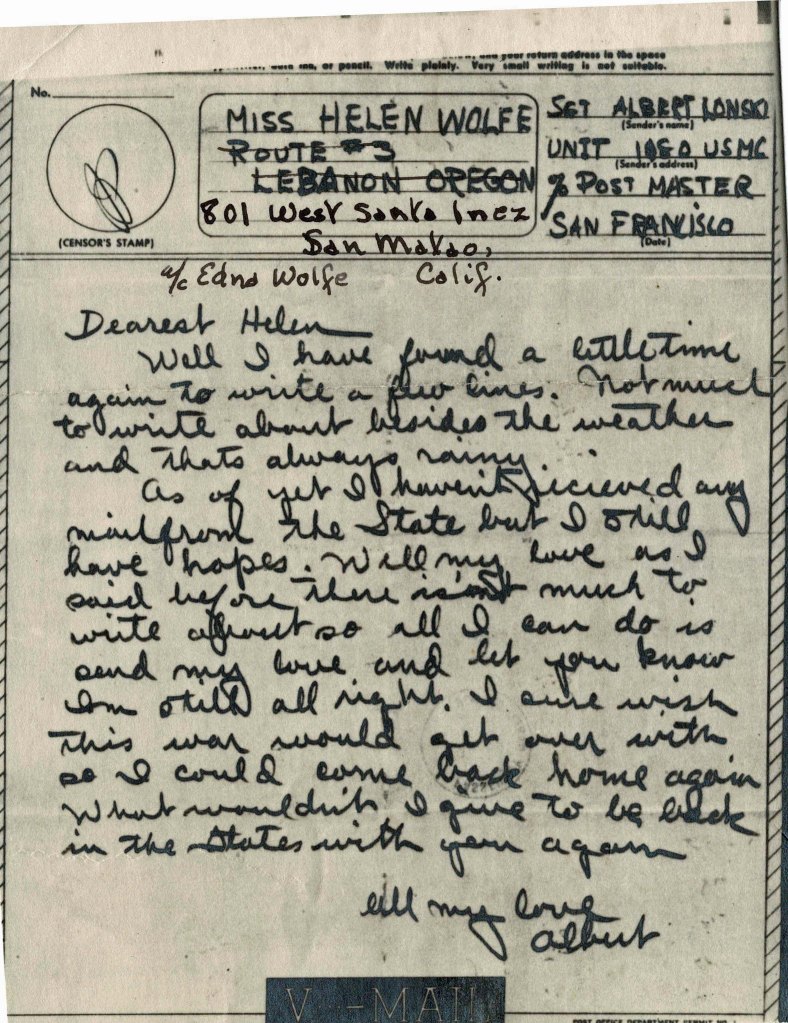
    Albert first sent this to Lebanon. Helen was in California with her mother, Edna Wolfe.

    The favorite letter Helen got form Albert reads.

    Dearest Helen, 
    Again, I find a few minutes to write you a few lines of my troubles. For the last couple of days it has been raining so much that we almost have to swim to and from our tents. The water is about 6 inches deep around our tent now and it is still raining. Oh, what I would do for a little bit of that California sunshine and a little bit of that moonlight with you. It's been 5 months since we left San Diego that November day and I haven't been with you, my love since that June day in Brawley, remember? I wish they would hurry up and finish this damn war so I could go back home to peace and quiet with you again.
    By the way, I still think of you all the time and miss you very much.
    This is a tropical hell hole without you; if you were here, it would be a paradise, my love.
    I love you,
    Albert

    Helen Goes to the European Front

    One reason Helen enlisted in the military was she hoping to be stationed close to Albert. She received basic training at Camp White in Oregon. She started here on January 13, 1944. On January 10, 1944, she became an army nurse and 2nd lieutenant. She saw duty in France, Le Mans and Charters. She arrived somewhere in England aboard the hospital ship, named Charles A Stafford in September of 1944.

    The journey from England to Normandy was difficult.

    The Tent Hospital

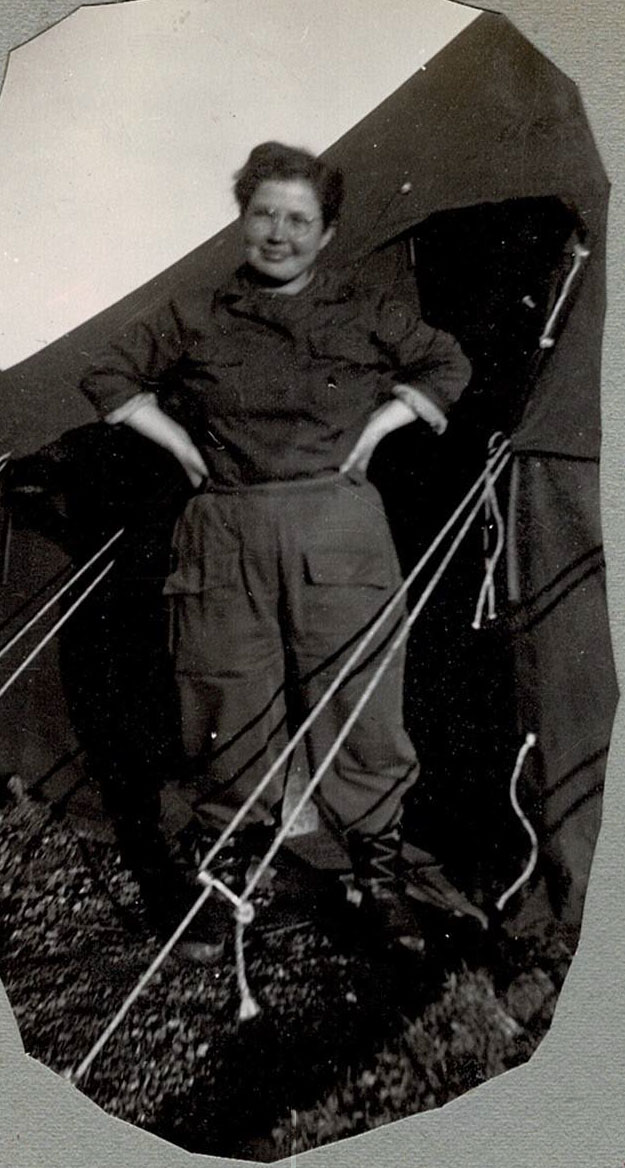
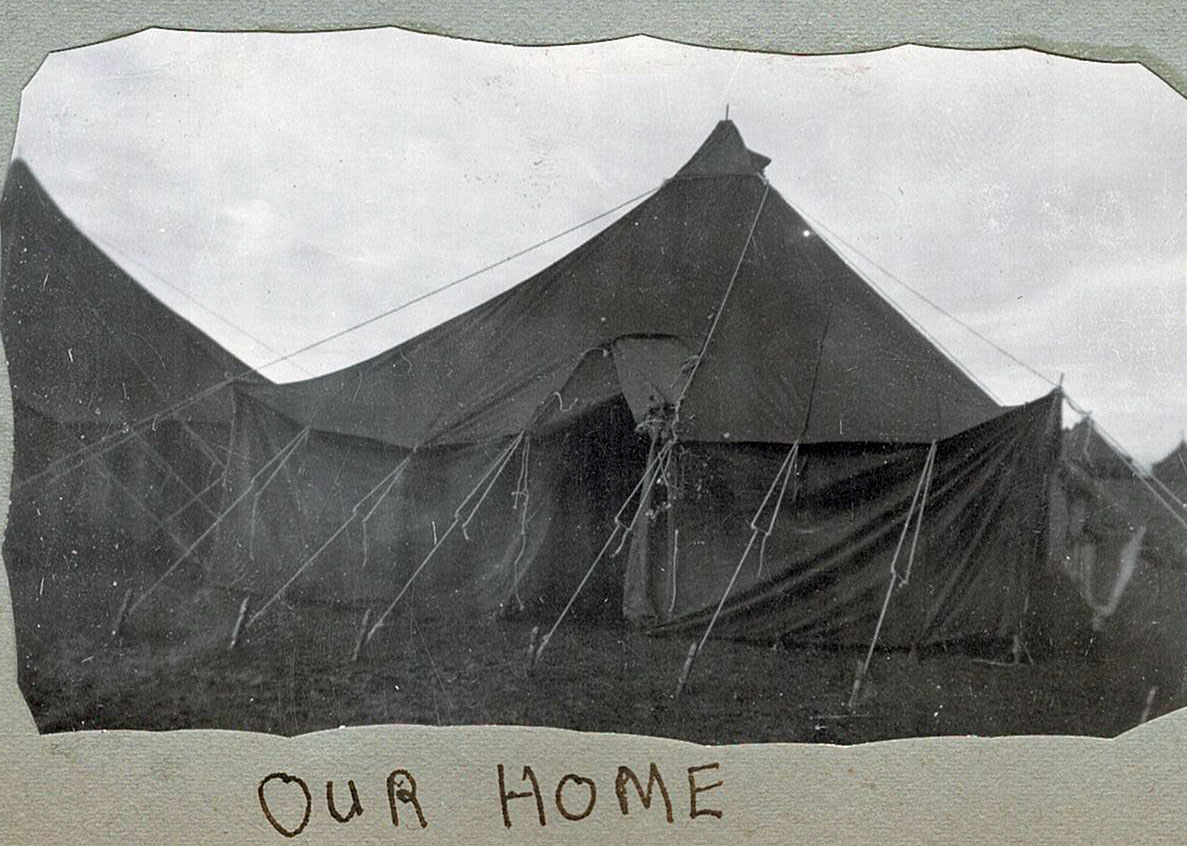
    This 1,000-bed tented hospital functioned as an Allied Military hospital. It operated between November 21, 1944, and April 5, 1945. After the April date Allied patients were transferred to other hospitals. The first few months at 170th General Hospital located near Le Mans, Normandy, France were cold, wet and uncomfortable. Helen arrived with the 83 nurses assigned to this hospital on November 13, 1944.

    Here is a description of early camp conditions from the WW2 US Medical Research Centre- Unit Histories- 170th General Hospital. The quoted information is from the Improvisation, procedures, equipment, manpower section.

    170th General- Le Mans, France

    Improvisations had to be made for the lack of certain equipment. Lamps were manufactured out of bottles filled with kerosene. Much borrowing from neighboring units had to be done to keep life from being miserable. The TAT (To-Accompany-Troops) equipment was hauled to the hospital site from the railway station.

    On 21 November, 404 patients were admitted, and there were still no ambulances for disposition and evacuation, the water supply was not yet declared potable, and electric lights were not yet installed. The coal allotment for December had been hauled in, and tents, stoves, and beds set up.

    Soon after the Hospital opened, a PW (Prisoner of War) enclosure was built, and before Christmas 250 German PWs and 28 French civilians were working in the Hospital Plant. It would not have been possible to efficiently run a hospital of this size with such a low T/O of personnel(T/O is short for Table of Organization and referred to a specified number of personnel). Forty (40) EM Enlisted Men) were tasked with guard duty alone. The 170th General Hospital had been operating under canvas since it opened on 21 November 1944, with the help of borrowed tentage.
    Unfortunately, only 8 wards had been winterized, and it took another three weeks before winterization of all the wards was completed. Stoves and fuel were now available, but there was no electricity. The unit managed to borrow one 30 KW (kilowatt) generator from the 19th General Hospitaland, after about two weeks, Engineers installed two of their own generators. No canvas repair kits were available, and as of 31 December, it was impossible to repair leaking tents. Lumber was missing, GC (Geneva Convention) Red Cross markers were nowhere to find, red and white paint was not made available. Circulating pumps could not be obtained, and therefore only one shower unit could be installed for the patients.

    The hospital staff had no accessible bathing facilities for three- and one-half months. The water was obtained from a 200-foot well on the grounds, and a concrete underground water tank of 15,000-gallon capacity served as the main storage tank. Individual washing was done by everyone, and there was no dry cleaning in the neighborhood. Everyone slept in his clothes, as it was too cold to undress without fires.

     Nurses had to keep wearing their class A uniforms, and had no sweaters, no leggings, no overshoes, other people missed overcoats, raincoats, and had no extra clothing. Luckily some extra combat clothing had been obtained on 7 November. Messing was improved after receiving ranges, but keeping food warm remained a problem, and the lack of certain items such as salt and pepper shakers and coffee cups caused problems when serving bed patients. There was a shortage of stovepipes, and there were insufficient personnel to operate everything, so, 60 PWs were employed in the three messes to help serve 1,500 to 1,600 people three meals a day. There was no concrete slab on the floors, no drainage gutters were provided, and dish washing facilities were totally inadequate …

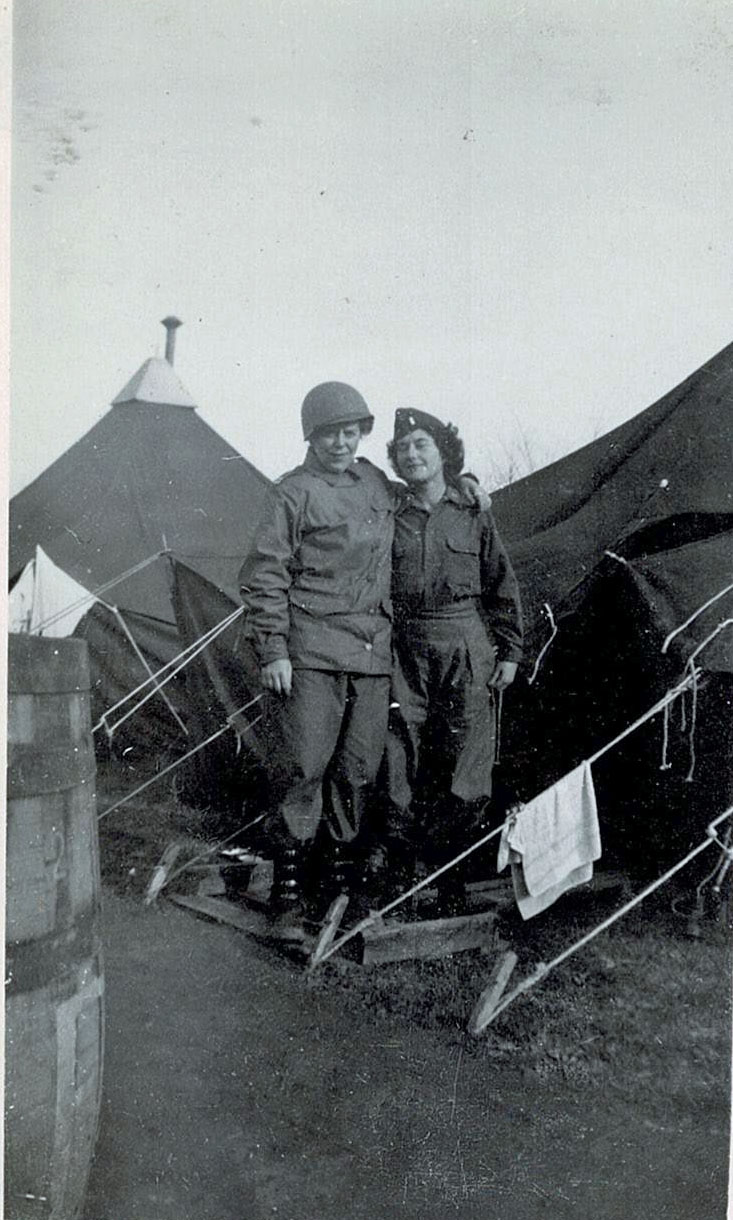
    Around this time Helen and her tent mates had a run in with General George Patton. This is what Helen said about this meeting.

    A Chance Meeting With General George Patton 
    Into our tent stamped a big bluff man with general bars on his shoulders. He was yelling, “what is all that female underwear doing in my command, 3 miles from the front.” We (the army nurses) had saved rainwater in our helmets and some drinking water with which we washed our panties and brassieres in our helmets. Then we hung them with large safety pins from the outside tent ropes. These items were dancing in the breeze. They were all different colors, and I thought they looked interesting, but not military. It did show women lived here and women determined to keep clean.
    He hooked a thumb at me. “Where is she going all dressed up?”
    We did have our good uniforms in our bed rolls. I had been invited for a dinner and a shower at the navy outfit camped on the still mined Utah beach.
    He yelled, “Get a fence up with clothes lines and hide that female underwear. I don’t like the Navy washing our Army girls.”
    I went to a shower and good dinner at the Navy camp. He stomped away yelling, “Female underwear 3 miles from the front.” But in a soft low voice I heard, “They are certainly pretty.”
    We had good showers the next day.

    By the end of November living conditions were better. Helen sent this letter to her Aunt Sigrid telling her about camp life. This was a little before they cared for many patients.

    4 Nov 1944
    Dear Aunt Sigrid & Maudie,
    We’re still in our cow pasture. We’re quite comfortable now. All in getting used to it, I guess. I don’t wear all that extra clothing I did at first.
    Hope you’re not working too hard. I ‘m, not yet.
    I’m staying home tonight trying to write some letters.
    There seem to be always some plan to go out such as it is. We ate steaks the other night. We’re getting stubborn and won’t go out unless they feed us.
    I’m trying to write and talk at the same time.
    We don’t do anything but a little drilling now and then. We have our bed rolls now and are warm enough. We’re sort of acclimated now too, so I don’t wear so many clothes around. In fact, I go to bed wearing only one pair of flannel pajamas.
    Would you send me some calcium tablets. We don’t get milk, and my nails are getting brittle, we get good food now though.
    Love, Helen

    The End of the War

    V-E Day, May 7, 1945, saw the end of the war in Europe. Helen wrote a poem.

    No War Now

    Listen to the silence.
    Hear the quiet.
    Feel the mystic moon sighing.
    Now, there is no crying
    Tonight. The World is at peace.

    on January 1, 1946 Helen traveled to camp Philip Morris. This was a large Army staging camp near the port of Le Havre, France. From here she returned to Presidio of San Francisco near San Mateo in the United States.

    Helen and Albert

    Albert was already out of the service. He had separated from the United States Marine Corp in September of 1945. He attended engineering classes at the University of Washington in Seattle. In February of 1946, he visited Helen in San Mateo. They married on February 26, 1946, in Burlingame. Here is Helen’s wedding photo.

    Helen wrote two poems about love.

    Pulse of Independence

    Two hearts ought not to beat as one.
    For if one stops,
    The other stops too.
    They should beat alone
    So, when lying close
    They do not sing a single note,
    But together they play a melody.

    Circles
    Love is not pie
    To be divided
    And slices given
    To friends and relatives.
    My love for you
    Is a full 360 degrees
    That encircles you,
    Front back and sideways.
    You cannot turn away from it.
    And if I choose
    To love a few hundred other people,
    It takes nothing away from you.
    For my love is expandable.

    Helen’s mother and aunts in Lebanon, Oregon honored the new couple with a reception in the spring of 1946. Helen wore the dress a German prisoner of war had sewn for her in France. This tailor fashioned the dress from a white silk parachute.

    Old Marrieds

    Here is a photo of Helen and Albert taken in 1980. Their last abode was at 33063 Berlin Road, Lebanon, Oregon.

    I wrote a poem about them at this time in their lives.

    Old Marrieds

    By Jill Foster

    The old man builds with rock, wood and colored glass
    Drawing his projects before.

    The old woman plants her gardens
    With trillium, dog tooth violets and abandon,
    Sowing her seeds freely.

    Th old man gives great, lavish gifts
    Planning months ahead.

    The old woman sprinkles presents about
    Buying books for any child she knows.
    Giving tidbits of home cooked treats to stray pets and people
    And kind words all around.

    The old man loves with his hands and eyes,
    Touching and looking his feelings
    Saving his words.

    The old woman gives volumes,
    Poems, postcards, letters,
    Using words to create gentle bonds
    And insightful meanings.

    These two bound together by choice
    Apart in their ways, stand together
    Making their world
    A little better.
  • The Disappearing Printer

    Post for Week 39

    There was one member of Frances Perritt’s family who disappeared late in life. I couldn’t find his death record, his burial site, or the place he spent his final years until recently.

    When I first met my husband’s family, including his great grandmother, Bessie Goughler, she spoke affectionately of all her three deceased husbands. George McClellan Goughler, the last of these three, was known to his grandchildren as Granddaddy Goughler. Bessie called him Mac, short for his middle name, McClellan.

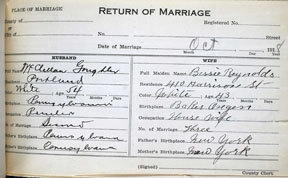
    Bessie married George McClellan Goughler in October of 1918 in Portland, Oregon.

    Here is a copy of their return of marriage. Mac was about 11 years older than Bessie and he was 54 years at the time of their marriage. He was born in Pennsylvania on January 19, 1864.

    I calculated his birth date from census records and this entry from his step granddaughter’s diary. Her entry from January 19, 1835, reads:

    Tonight, Bill and Helen were over for dinner. It was Granddaddy’s and Helen’s birthday, so we celebrated.

    from Rose Coursen’s diary written while she was living with Mac and Bessie in 1935

    I found Helen Goughler birth certificate online. It was a typical adoptee certificate with the adoption parents listed as as parents. Helen birth date was January 10, 1906 which matches the newspaper story to follow.

    McClellan, The Printer

    Before both of his marriages, Mac was a member of the International Typographical Union. Mac Goughler ran to be elected to the executive committee for this organization. This was reported by the Oregonian newspaper on 29 March 1893.

    Mac Goughlers name came up in another article, dated September 1, 1913. This article in the Portland Labor Press told stories about early members of this union and mentioned Mac.

    It said that he was a job man and joked about his name. Here is the quote from the article. ”Mac Goughler’s ire was aroused because everybody persisted in calling him ‘MacGoogeler’ which was not his name by any means.”

    Today, to google something means to look online for information about it. In the story, Mac’s friends were using a corrupted form of the word goggle”. To goggle meant to stare with a wide-eyed look.

    Mac did wear glasses.

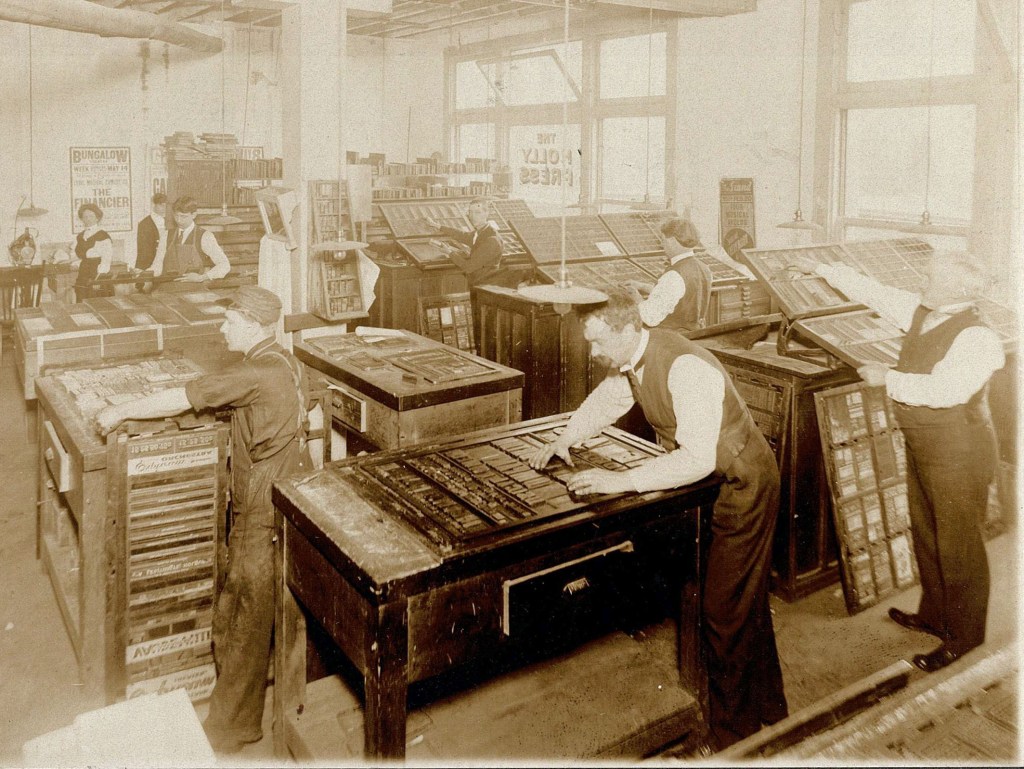
    Holly Press

    McClellan Goughler and Chris Hansen were owners of Holly Press. Their print shop was located at 66 1/2 1st in Portland, Oregon.

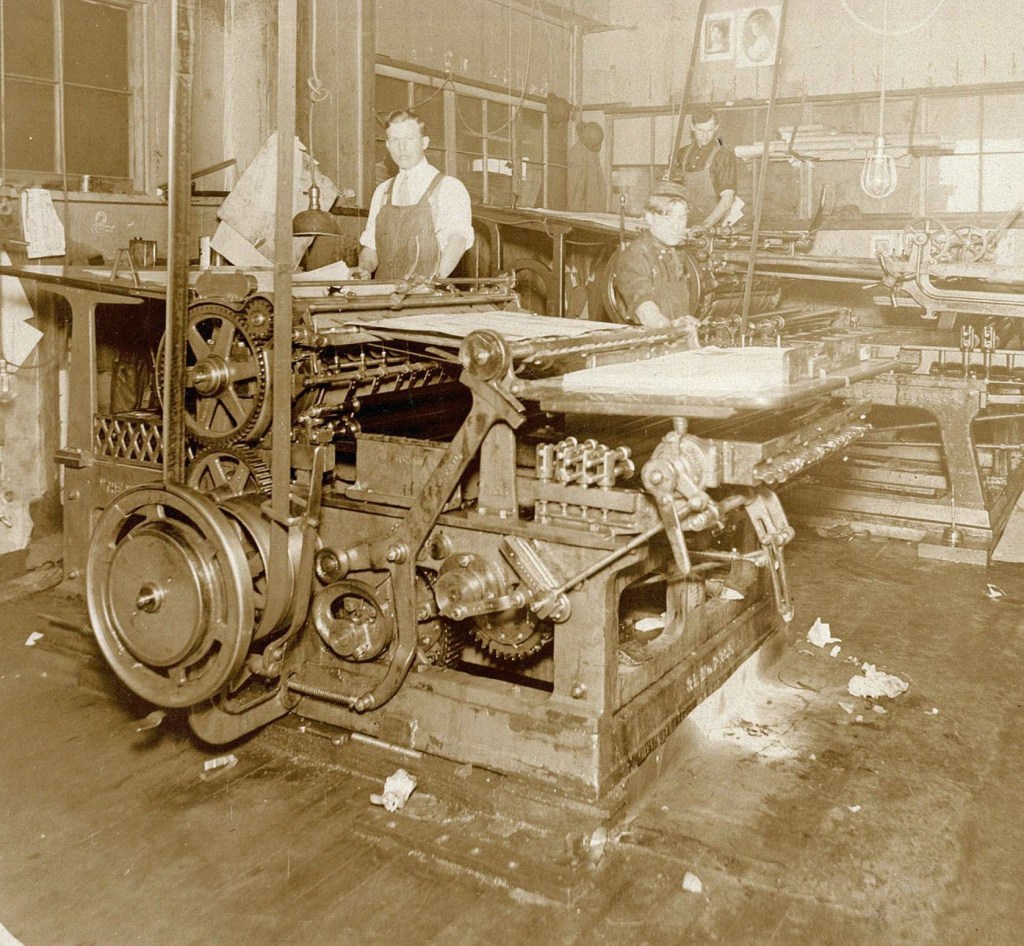
    Here are two photos of this print shop, Holly Press.

    Holly Press
    Holly Press

    First Marriage

    Mac married Daisy in Yamhill County, Oregon on July 4, 1984. They remained childless until Friday night, January 19, 1906. This is what happened as told by the Morning Oregonian a few days later.

    Will Adopt the Baby

    Mr. and Mrs. McClellan Goughler, living at 794 Clackamas Street, will keep the baby girl, which was left at their home Friday night, and have named the waif Helen. At 9:30 o’clock that night the doorbell rang, and on answering it, Mrs. Goughler (Daisy) found on the doorstep a baby, that at once won a place in her heart and home. There was nothing about the infant that might lead to the identity of the parents. It was wrapped up in an old blanket. The baby is about 19 days old, and is a healthy child, and Mr. Goughler is as willing as his wife to give it a home, as they have no children of their own. They have accepted the baby girl as a gift from the mother whoever she may be.

    City News in Brief, Morning Oregonian (Portland Oregon)Wednesday 24 Jan 1906, p.9

    Mac and Daisy Split

    In 1913 and 1914 Daisy Goughler showed up in the society pages of Portland, Oregon newspapers multiple times. She attended and hosted events as Mrs. McClellan Goughler or Mrs. M. Goughler. Occasionally her husband, Mac attended with her. In 1916 society news of her decreased dramatically. It looked like trouble for the Goughlers. But Daisy was still listed as McClellan Goughler’s wife in the Portland City Directory for 1916. They live at 415 12th Street.

    In 1917 Mac and Daisy separated. Mac moved to the Lenox Hotel. He is listed in the Portland City Directory as being a resident of that building.  In 1918, Mrs. Daisy Goughler is living at a new street address- 389 Main Street, Portland, Oregon.

    By 1920 Daisy Goughler had moved to Seattle, Washington. She worked for a corset company. On the 1920 census for Seattle, King County, Washington, Daisy Goughler is divorced and boarding with Jack and Emily Holmes.

    In 1920 this date, their adopted daughter, Helen Goughler lived with Mac and Bessie.

    The Studebaker

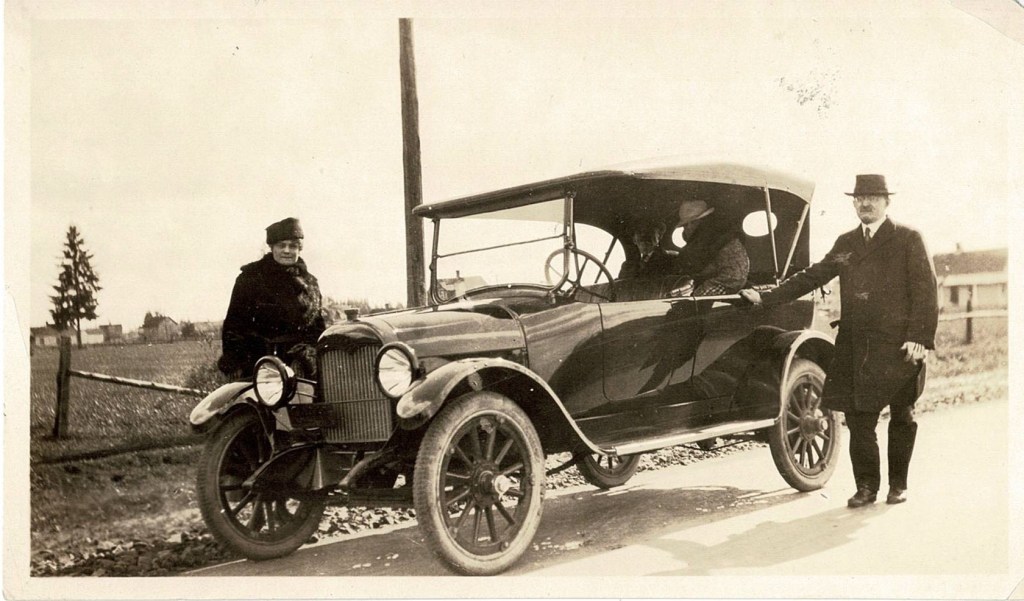
    The same year that Mac and Daisy separated, Mac bought a 1917 Touring Studebaker. He registered the car with the Oregon Motor Vehicle Department. His license number was 10087.

    Here is a photo of this car with Bessie and Mac taken a few years later.

    Mac’s Years with Bessie

    Here is a photo of Bessie and Mac before they married. They are at Multnomah Fall with some of Bessie’s siblings.

    Back, George Reynolds, Louis Reynolds, Frances Reynolds Cooke and Louis Cooke, Front, Mac and Bessie Goughler, Mary Lydia (Mamie) Reynolds

    Their Residences

    The census records showing Bessie and George McClellan Goughler as a couple include those from 1920, 1930, 1940 and 1950.

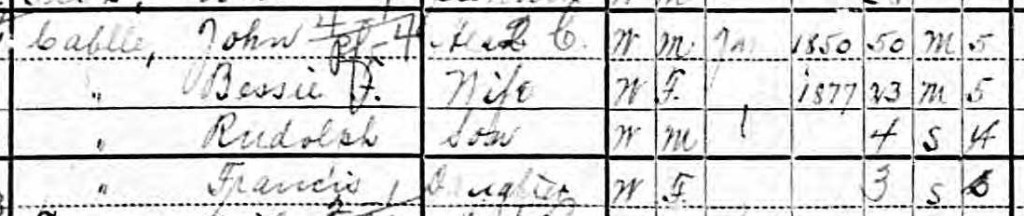
    In October of 1918 George McClellan Goughler and Bessie Reynolds Cabell Curtiss married and set up housekeeping together. They first lived at Bessie’s place, 410 Harrison Street in Portland. They were still there when the 1920 Census was recorded in Multnomah County, Portland, Oregon.

    According to the 1920 census for this area, Rodolph W. Cabell, Bessie’s son, and Helen C. Goughler, Mac’s daughter, lived with them. Mac worked at his company, Holly Press which he owned with Chris Hansen. This record recorded Mac’s name as George M. Goughler.

    By 1930, they had moved to the house on 47th Street North. Mac’s daughter, Helen, still lived with them. The 24-year-old Helen taught music. This record values their home at $6,000.00. Here Mac gives his occupation as a printer of posters.

    House on 47th Street

    By 1940, Mac is no longer working outside the home. He and Bessie still live on 47th Street. Their house is listed as 3415 NE 47th. Mac’s name is recorded as George M. Goughler.

    In 1850, this couple still live at the 3415 NE 47th Street house. By this time Mac was 87 years and Bessie was 75 years. They had been together 32 years.

    The Aging of the house on 47th Street

    Here are two more photos of their Portland home taken another angle.

    house after remodel
    about 1936 showing Mac, Bessie and Betty Coursen, Bessie’s granddaughter

    Looking for Where Mac Died

    The 1950 census record is the last record I have of Mac in Portland.

    Looking for Where Mac Died

    I did find George McClellan Goughler burial site but not where I expected. It was more than 10 years after I started looking. Death records for Washington, Oregon and California yielded nothing. He was not buried in the River View Cemetery where his wife, Bessie, was buried. He was not listed in the Social Security index. I searched area newspapers for his obituary.

    For a long time, I felt like Mac had disappeared from Portland and Oregon altogether. But George McClellan Goughler had an uncommon name. I tried a global search on Find a Grave. I typed in only his name. A George M. Goughler came up. This George was buried in Evergreen Cemetery of Colorado Springs, El Pasco County, Colorado. A search of this city’s cemetery record showed the middle name as McClellan. A large sign for section 242 held many names. The burial date for George M. Goughler was given as September 10, 1952.

     As a result of all this looking, I found an institution in Colorado Springs that cared for old sick printers. George was a member of the International Typographical Union. He qualified for health care at the Union Printers Home.

    George McClellan Goughler was the type of man an unwed mother would give her baby to raise. I feel sad that were no obituaries for him at the time of his death. So here I am, sharing Mac’s memories 88 years after his burial.

  • Images

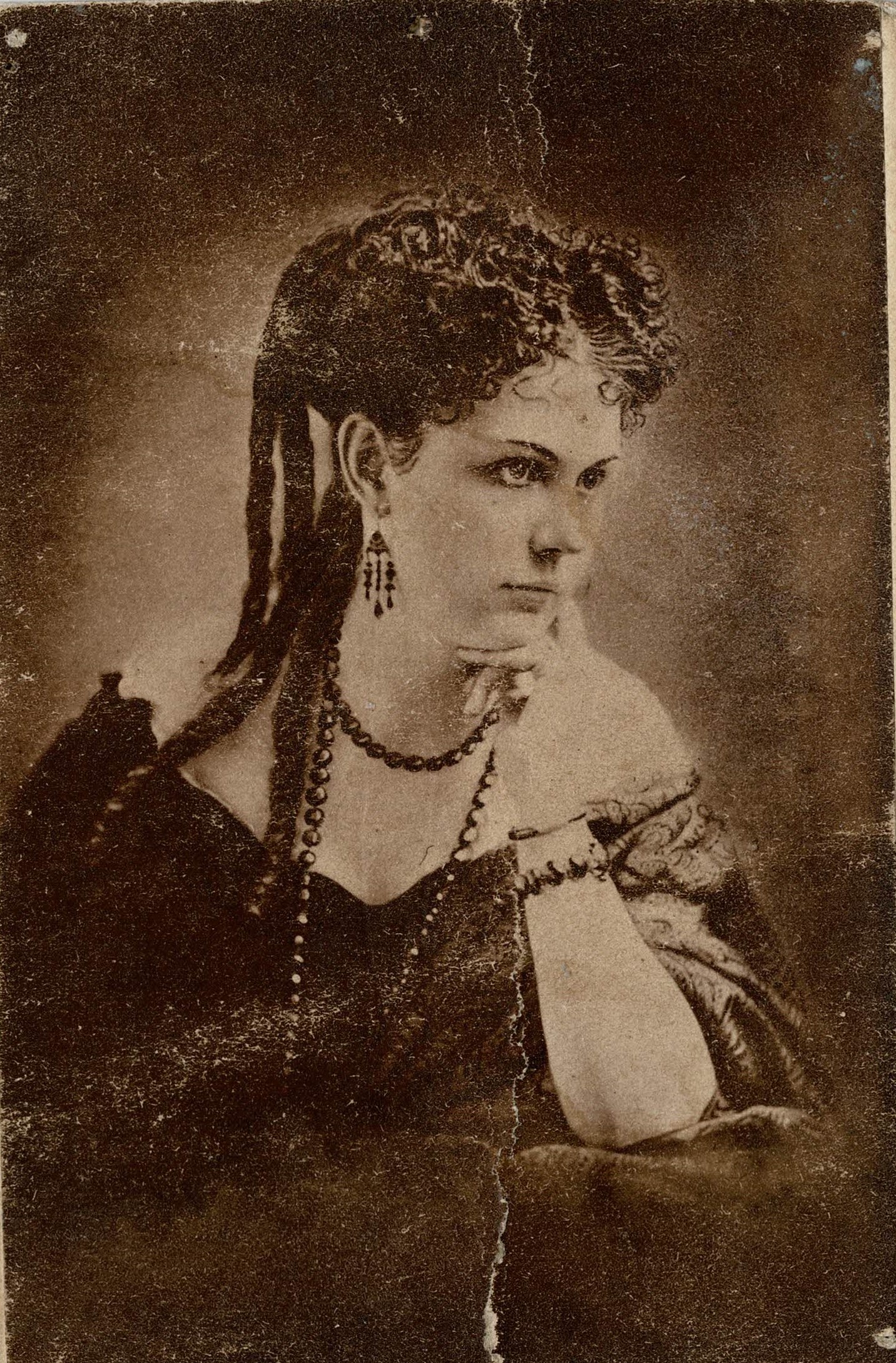
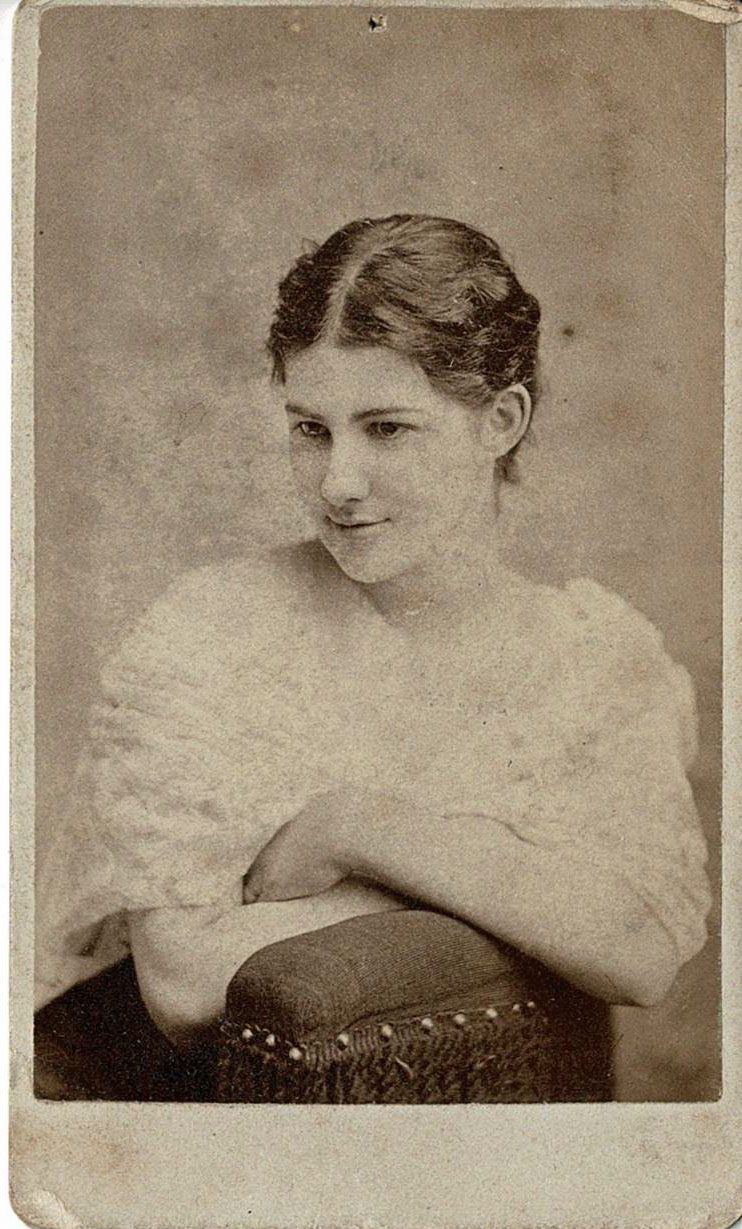
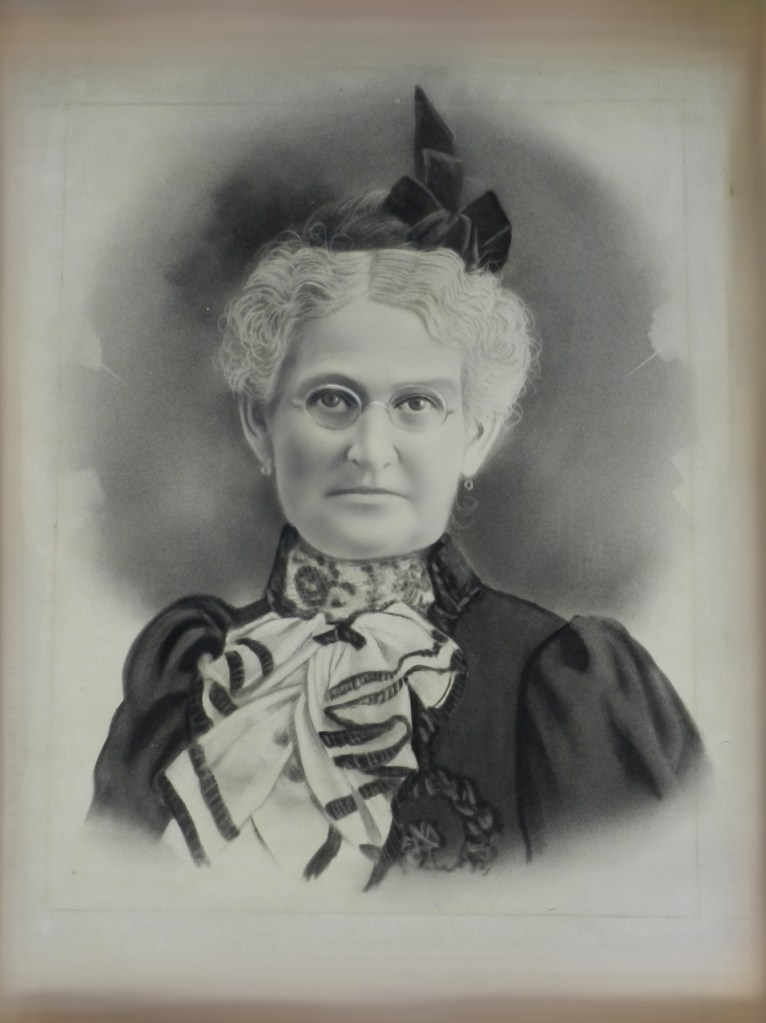
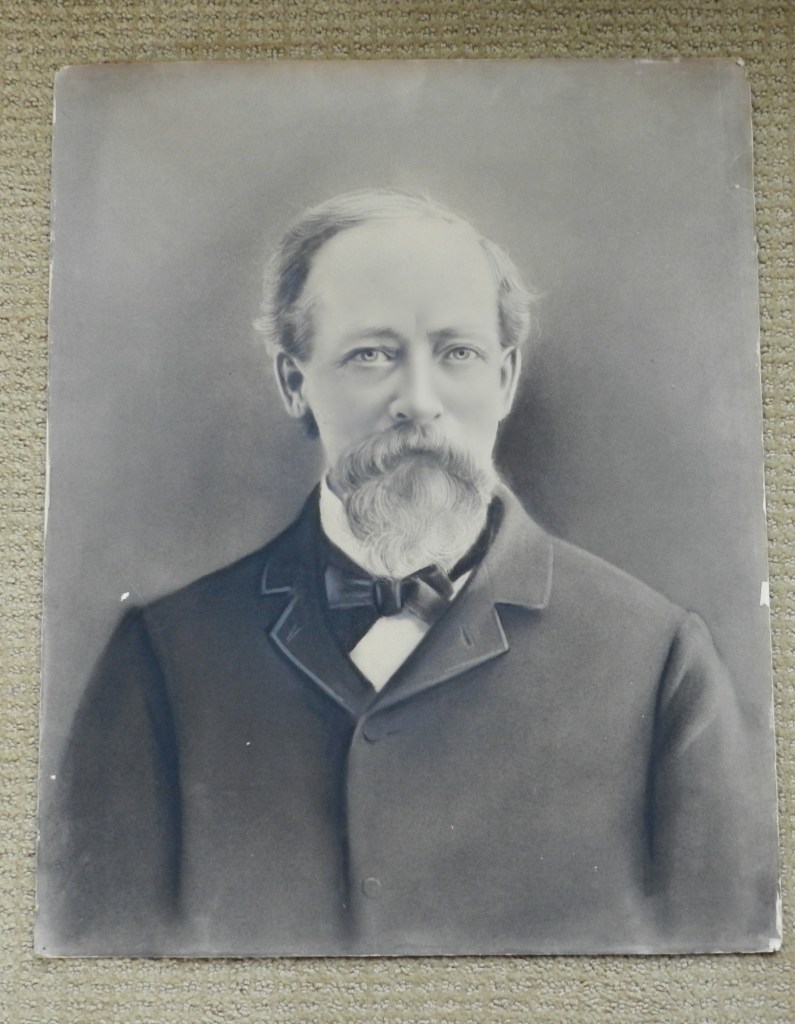
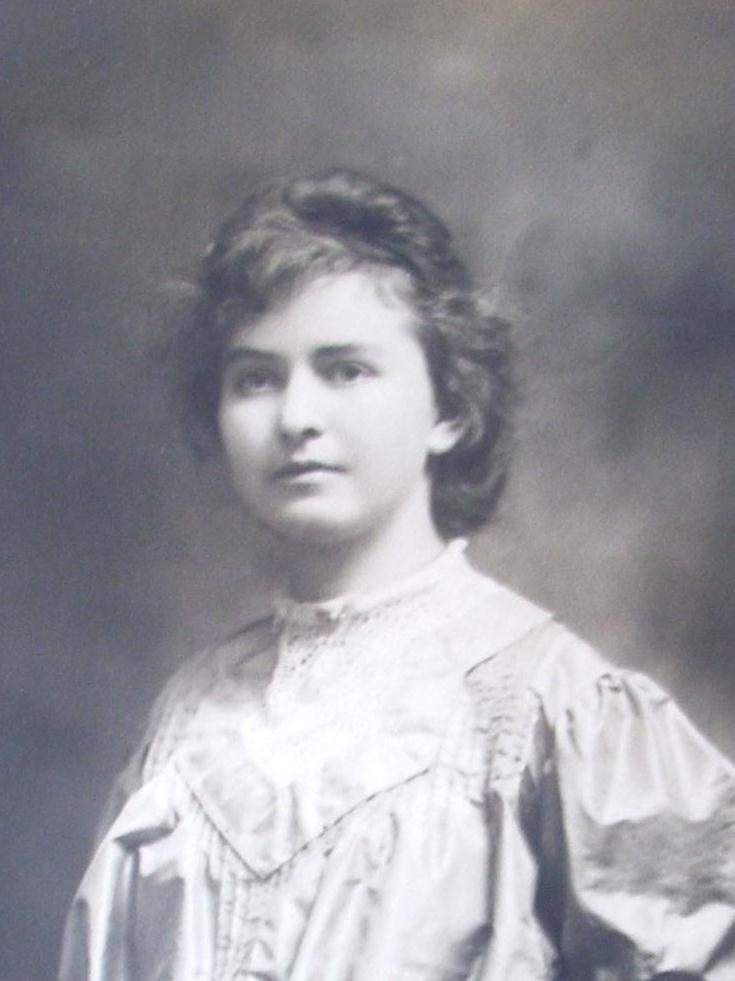
    I recently looked through my old treasures from the Ferguson family. I thought I should photograph these four big portraits. These people are related.

    In 2010 after the death of Aunt Betty Coursen Miller (gg granddaughter of Daniel Ferguson), Betty’s children give me family photos from the Ferguson Reynolds side. These photos are large, measuring 16″ by 20″. The images are on cardstock, yellowing, crumbly, and labeled as follows:

    Two photos had writing on the back on the back in what looks like Bessie Reynolds Cabell’s writing. One reads “Margaret St. John Ferguson.” This label gives information about who had the photos copied. It says, “Mrs. J. B. Cabell Baker City, Oregon, crayon, 3-18-02, April del W. Bowston.” April del W. Bowston was the artist who enhanced this portrait with crayon. Mrs. J. B. Cabell (Bessie Reynolds) was the granddaughter of Daniel Ferguson.

    The second photo has, “Edwin Wesley Reynolds married Margaret St. John Ferguson” written on the back. These first two photos made by photographing smaller photos of Margaret and Edwin. These smaller photos were taken in Baker City at Parker’s Studio around 1901. I have 4 /2” by 6 1/2″ photos of both identified as Edwin and Margaret Reynolds. Margaret’s age at Baker City sitting for the original photo was fifty-four.

    The third portrait was a drawing of Daniel Ferguson. It had a masking tape label saying, “Daniel H Ferguson married Jeannette Keller.” It was the one in the most deteriorating condition. It looks like a drawing.

    The fourth portrait shows a young woman about 18-years-old. She wore a white dress and has a mysterious smile . She looks very much like a younger version of Margaret. But the label on this lovely young lady photo reads, “Jeanette Keeler , wife of Daniel Ferguson.

    If this photo was taken of a 18-year-old Jeannette, the year would have been 1834.

    In the end, I decided this, too ,was a photo of Margaret Ferguson.

    None the less, these are some of my favorite photographs.Also they are an useful introduction to the next part of the Daniel Ferguson family story.

    Margaret’s Education

    Chances are greater than not that Margaret learned to draw quite young. 

    When Margaret was a young girl in the 1850s, opportunities for girls and young women were meager. Fewer opportunities exist in Oregon Territory. But in Oregon City just across the Willamette River starting in 1853, there was Clackamas County Female Seminary. Reading, writing and simple math, French, drawing and monochromatics were taught to the girls.   Monochromatics is drawing using shades and tints of one color. To attend this school for an 11-week quarter it cost six dollars. For an extra two dollars, the drawing lessons were offered.

    Some of Margaret’s art has been saved by the family. The drawing of her father, Daniel Ferguson, was probably Margaret’s work. Another piece, a mother and child drawing in the monochromatic style has Margaret name at the bottom of the piece.

    Here it is.

    Margaret signed this as Maggie Reynolds

    In 1857 the school faced financial ruin and was closed for a year. It reopened in 1858 under new management.

    Not long after this Daniel moved his family away from Oregon. Here is an ad placed by W. Blain in the Oregon Argus. It announced that the property on the hill above Linn City was for sale. This revealed that the Fergusons were still in Linn City in June of 1858. The whole family was there when the Oregon territorial census was taken in 1856 and 1857. Daniel, Jeannette, Elbert, James and Margaret left friends, neighbors. They also left a breath-taking view of Mount Hood when they left Linn City. They left for a home on the Columbia River in Washington Territory where the Cascade Rapids impeded river boat travel. And the 12-year-old Margaret probably had to give up drawing lessons.

    View of west side of Mount Hood

    They moved into a new house in Cascade City while still owning a house in Portland.

    Cascade City

    The next year the Fergusons moved to Cascade City also known as “Lower Cascades”. Cascade City developed around the army Fort Cascades. this fort was located on the north side of the Columbia River near today’s North Bonneville. In the 1860s, Cascade City was the largest town in Washington Territory and an important steamboat stop. Daniel’s neighbors, the Bradford brothers, owned dock and portage here. They took advantage of the passengers and cargo that had to bypass the river at Cascade City.

    The 1860 U.S. census listed 142 towns’ people in Cascade City. Also, there were 52 personnel at the garrison at Fort Cascades. At the beginning of the Civil War,this fort was abandoned by the army Then the town took over the fort.

    The Fergusons were listed in this census for Washington Territory, Skamania County and the town of the Cascades. They lived in dwelling number 602. Their surname was spelled incorrectly and written as “Fergerson”. Daniel H. Fergerson, a 46-year-old male headed this household. He was said to be a hotel keeper from New York. His family, Jeannette, aged 46, Elbert, aged 17, James, aged 15, and Margaret, aged 13, were listed next. Also, living at dwelling 602 were Thomas Pike, age 30, a ship carpenter, Albert Perval, age.

    A 21-year-old clerk named E. W. Reynolds lived close to the Fergusons in dwelling 600.

    Image of 1860 census, The Cascades, Dwelling 600 and dwelling 602

    The Teenage Margaret

    The house, mentioned in the 1860 census record as dwelling 602, was a second home for the Fergusons. They still owned a home in Portland, Oregon. This new home, like their other homes, fronted a major waterway used for shipping and travel in Oregon.

    Travel between their Portland home and their Cascades home was easy considering the times. If a person climbed aboard the Carrie Ladd of Captain Ainsworth’s fleet, the trip took a little over seven hours. It took five hours forty minutes to go down the Columbia to Vancouver, then 90 minutes inland to Portland.

    The Columbia River also marked the boundary between Oregon State and Washington Territory. The Fergusons lived on the Washington Territory side of the Columbia River.

     Living in Cascade City was more of a do-it-yourself affair than living in Portland and the Fergusons had hungry boarders. Margaret and her mother cooked on a cast iron stove. So, there was wood to chop, a fire to build and feed. Then, when cooking Margaret needed to monitor the fire to keep the temperature ideal.  To make a chicken dish, the chicken had to be caught, killed and plucked first. There was no refrigeration, so the roast chicken would have to be eaten soon after being cooked. William Moffitt was the area’s butcher, so there was beef.

    A root cellar kept vegetables like potatoes, carrots, parsnips, and turnips.  More perishable fruits and vegetables would be canned in mason jars. The climate being hot and dry during the canning season made this work hotter. The climate in the winter was cold and wet.                                                                                                                       

    Schools didn’t exist in Skamania County until Felix Iman and John Nelson built a log cabin schoolhouse in Stevenson. Stevenson, about two miles from Cascade City, still exists. The town was destroyed by flooding in June of 1894.  See more about Cascade City.

    Shortly after this census was recorded, circumstances in the Ferguson family changed. This left mother, Jeannette and daughter, Margaret with the work of running their hotel.

    Elbert, sick with tuberculosis died December 9, 1863. The family buried him in Portland, Oregon at Lone Fir Cemetery. In the 1860s, tuberculosis was the leading cause of death in Washington County, Oregon.

    James Ferguson went to Portland to clerk for the Harker brothers in 1861. The Harker Brothers, wholesale and retail dealers, sold clothing and dry goods. Their building was located at 53 Front Street, corner of Oak in Portland. James worked there for four years.

    Daniel built businesses in Washington Territory selling goods to miners in this big territory. He also mined for gold himself.

    So, at home in Cascade City, Margaret and Jeannette kept the home fires burning.

    Margaret’s Romance

    The clerk, living in B. F. Bradford’s house or dwelling 600 on the 1860 census record, noticed Margaret and she noticed him.

    The family believes Edwin came west in 1849. When Maggie met him, he was working on a steamer on the Columbia River.

    Edwin Wesley Reynolds married Margaret Ferguson on March 2, 1864. They were married at their Portland house with Jeannette and her brother James Ferguson as witnesses. The Ferguson Family Bible says:

    Edwin W Reynolds and Margaret were married in Portland, Oregon the year AD 1864 by the Rev Mr. Cornelius, a Baptist minister

    The young couple are listed in the 1870 census record for Baker City, Oregon.

    They lived in dwelling no. 4. Ed W. Reynolds, age 32, occupation, retail grocer had $2000 in real estate and $2000 in personal property. He was born in New York. Margaret Ferguson, age 22, occupation, keeping house, born in New York was listed next. The three children, all born in Oregon were George P., age 5, Addie J., age 4, and Frances G., age 3, were listed next. Lastly, Jeannette Ferguson, aged 53, born in Connecticut was listed.

    James Ferguson lived next door. He was in business with Margaret’s husband, Edwin Reynolds. Here is a copy of this record.

    1870 Baker City Census showing The Fergusons and the Reynolds

    So, now the Ferguson family is based in Baker City, Oregon except for Daniel. He was gold mining in Cerro Gordo located in California.

  • Too Much Fire in the Box

    I have been writing a series of blogs about Daniel Ferguson and his family. Even week 7, Fanny’s Letter, touched on this family.

    My series started with week 28, Traveling by Mailboat. Then came week 43(urban) with City Girl. The city girl was Daniel’s wife, Jeannette Keeler Ferguson. After that for week 41(water), I wrote Water and Steamboats. This time I am working on week 42(fire). My title is “Too Much Fire in the Box”. It details the Gazelle’s explosion. This happened on the Gazelle’s first regularly scheduled run on the upper Willamette River in Oregon Territory.

    Questions

    I struggled with a few questions while researching this important event in Daniel Ferguson’s life. Why isn’t Daniel mentioned in the aftermath of the explosion? Why did Gazelle’s two boilers explode? Why did the explosions happen simultaneously?

    The Superintendent Question

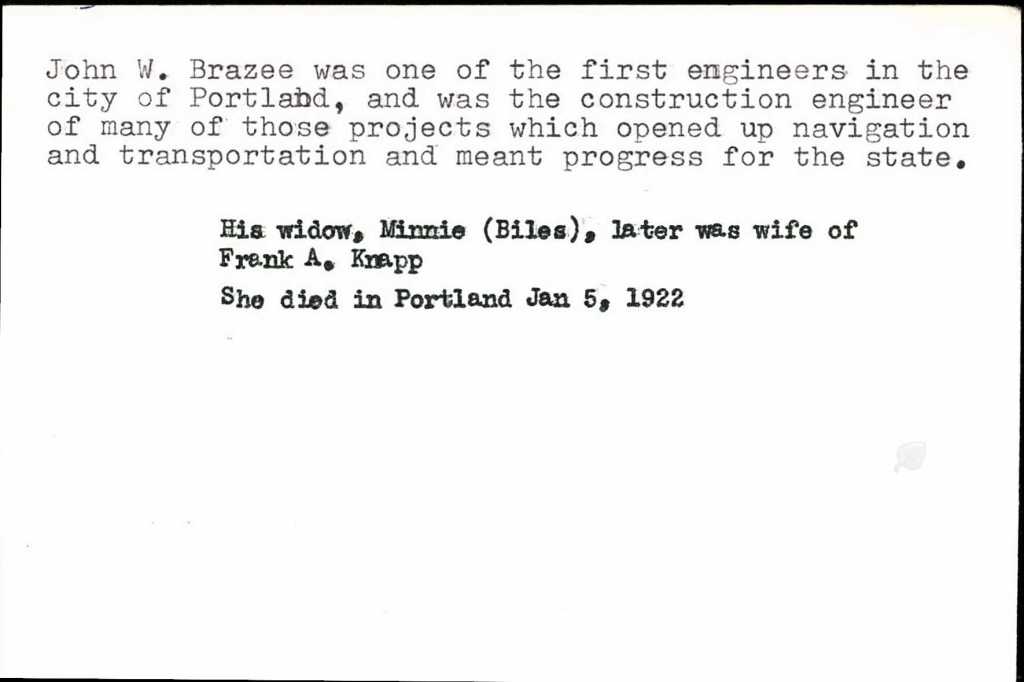
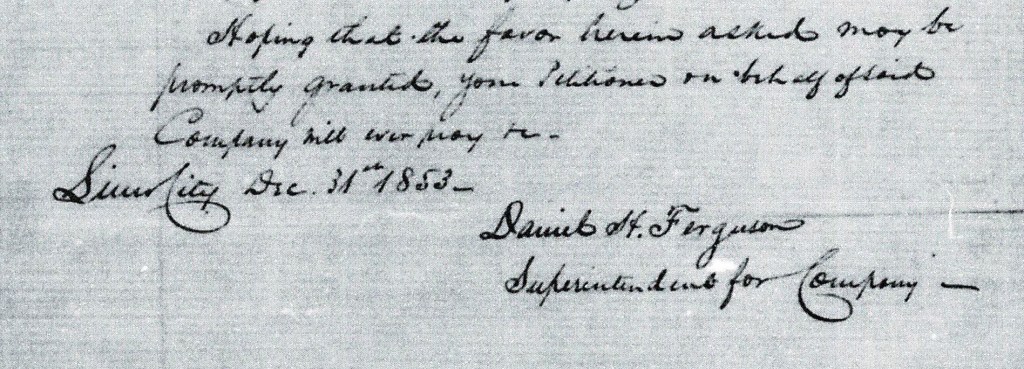
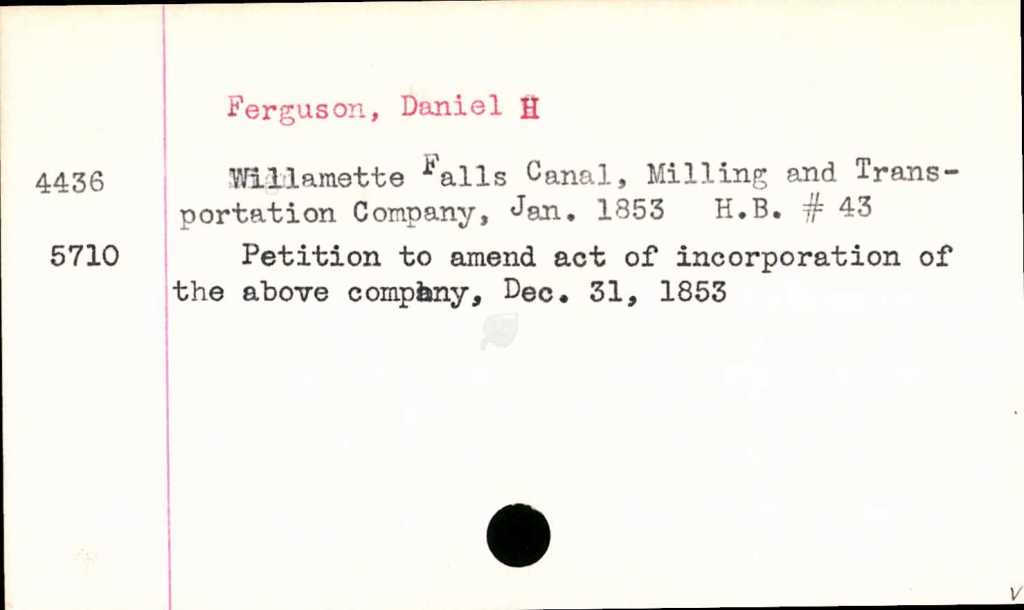
    If Daniel owned the Willamette Falls Company, he would call himself anything he wanted in reference to his company. He preferred superintendent. He called himself that up until the first regular run of the steamboat. In news items and government documents, Daniel is listed as the superintendent of the Willamette Falls Company. Here is a copy of an index card I found at Oregon State Archives in Salem, Oregon. I have copies of the two documents noted on this card. Here is his closing sentence and signature on the petition to amend act of incorporation.

    Daniel Ferguson, “Petition to amend act of incorporation of the Willamette Falls, Canal, Milling and Transportation Company,” Oregon Territory, Washington County, Dec. 31, 1853, Territorial and Provisional Government Papers, Oregon State Achieves, microfilm no. 5710, accessed: April 2019 (http:sos.oregon.gov/archives/records

    The document titled house bill #43 was approved on January 15, 1853. Daniel Ferguson, C.W. B(unreadable)ley and Colin C Baker are named as associates in this incorporation venture.

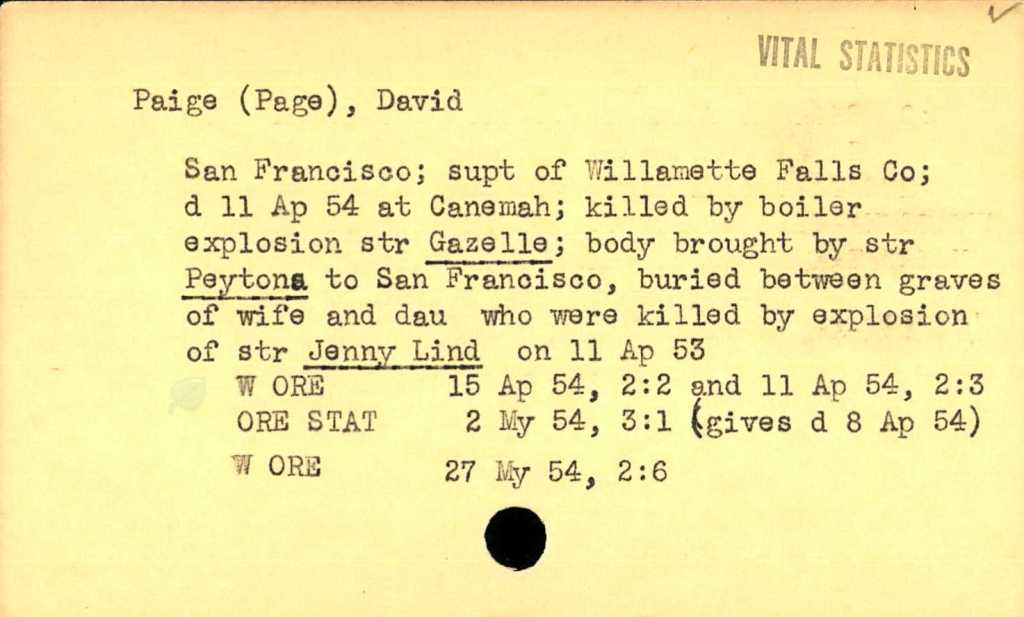
    Sometime in March of 1853, David Paige came into the business. This man surely was the one Daniel sold and conveyed the Willamette Falls Company to on March 19, 1853. David Paige was not a ship builder, but his company, Paige, Bacon & Co. financed two steamboats for river transportation here. This company’s intent was to control transportation in Willamette Valley. Canemah, located above the falls on the upper Willamette River, was the building site. The second steamboat Paige’s company built, the Gazelle, was finished in March of 1854. Their first boat had burned on October 6, 1853, at Oregon City.

    Here is a copy of another index card I found at Oregon State Archives in Salem, Oregon. This one tells a little about David Paige.

    Even after Paige bought the company Daniel did not leave. Daniel remained as superintendent .David would be the chief superintendent.

    On December 31, 1853, Daniel sent a petition to the Oregon legislature to amend incorporation of the Willamette Falls Company. He asked for 6 months more time. This document mentioned Paige’s lost steamboat. The calamity Daniel speaks of was the loss of this boat by fire. He writes:

    In support of the extension of time, say for six months, your petitioner would only urge this (because of) the magnitude of this undertaking and the happening of the calamity which no reasonable foresight could have avoided. It’s a pledge of future fidelity, in their public engagement to execute the work; your petitioner points to the acts and labors of the company during this past summer and hopes they may be regarded as an ample guaranty. Their improvement can be completed in six months and will be.

    Daniel Ferguson, “Petition to amend act of incorporation of the Willamette Falls, Canal, Milling and Transportation Company,” Oregon Territory, Washington County, Dec. 31, 1853, Territorial and Provisional Government Papers, Oregon State Achieves, microfilm no. 5710, accessed: April 2019 (http:sos.oregon.gov/archives/records

    More About the Gazelle

    The Gazelle, a twin engine side wheeler, had 2 high- pressure boilers. These were tube type boilers. The engines, being built back East, needed to be shipped around the horn to the west coast. About the time these engines were built, the Steamboat Act of 1852 was passed. This act required boilers to be tested and fitted with pressure relief valves. Since there was a report saying the chief engineer tied the pressure valves down, the Gazelle had pressure valves.

    The First Regular Trip of the Gazelle

    It happened on the day of the Gazelle’s first regular run at 6:30 a.m. on April 8, 1854. The Gazelle was loaded with 60 people and tied up at the dock at Canemah. The engineer, Moses Tonie tied the safety valve of the steam engine down to make the departure fast. Tonie noticed something was wrong and made his own exit. A minute later both engines exploded. Of the 60 on board 20 people died at once and four more died later. Moses Tonie was later charged with gross and culpable negligence. He allowed too much steam in the boilers. The water levels got too low.

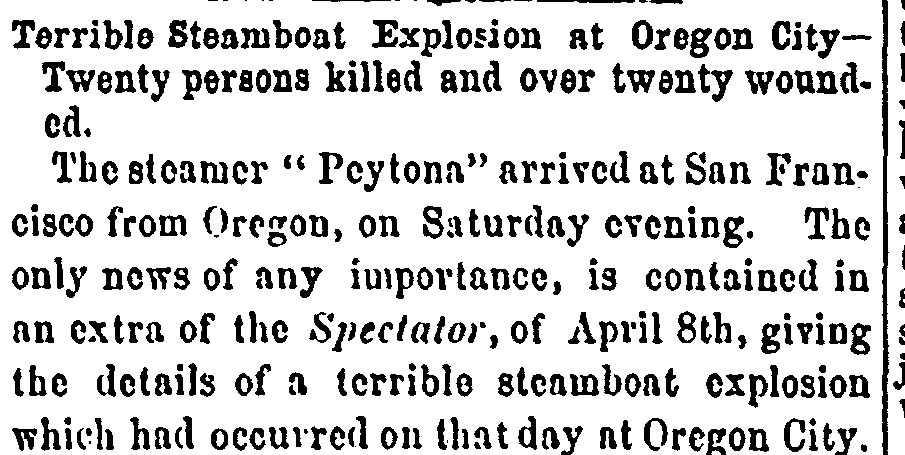
    Here is a newspaper clipping from the Daily Placer Times.This California newspaper copied an Oregon Spectator article from April 8, 1854. News from Oregon came by steamer.

    “Terrible Accident,” Weekly Oregonian, (Portland, Oregon), April 15, 1854, p.2, col. 2, digital images, GenealogyBank.com,  (http://www.genealogybank.com, accessed: May 4, 2019)

    The Oregon Spectator printed this on April 8, 1854 describing the reaction of the Oregon city town’s people. It reads:

    This distressing disaster has thrown a deep shade of gloom over the whole community. Stores, shops, iron works, mills are closed for the afternoon–business generally is closed. In Canemah, a feeling of intense grief is manifested by nearly everyone to be seen. Col. White, Mr. Post, Jho. P. Brooks and others, generously open their places of business and spare rooms for the benefit of the wounded, and for the dead bodies, until they are recognized and cared for by the respective friends.

    The coroner’s report blamed Moses Tonie for the accident. Tonie did not testify. He ran from the exploding boat and then fled to Washington territory. He wasn’t seen again.

    This unhappy event ended Willamette Falls Company’s brief steamboat operations on the Willamette River.

  • The Traveling Baby Grand

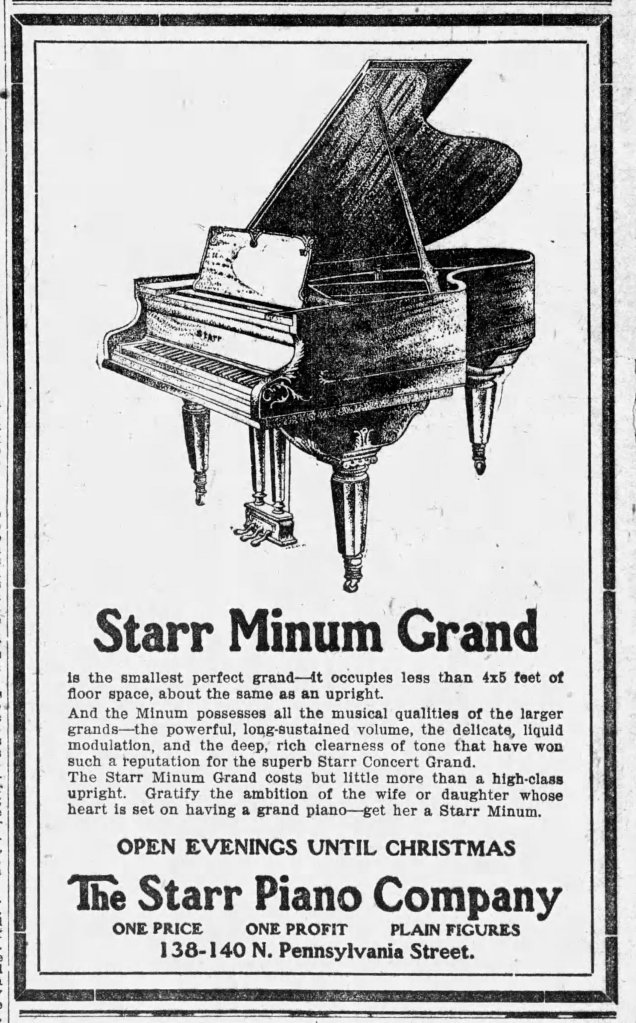
    Starr Minum Grand, The Indianapolis Star, 16 Dec 1906 p. 52

    I wrote this post for week 34 of the 52 Ancestors in 52 weeks for 2025. The ad at the beginning of this post shows the Minum grand piano built by the Starr Piano Company. I found this ad in the Indianapolis Star, dated December 16, 1906. I saw and heard this piano at my husband’s grandmother’s beach house in 1968. It, along with the human piano player, produced a lovely mellow clear sound as indicated in the ad.

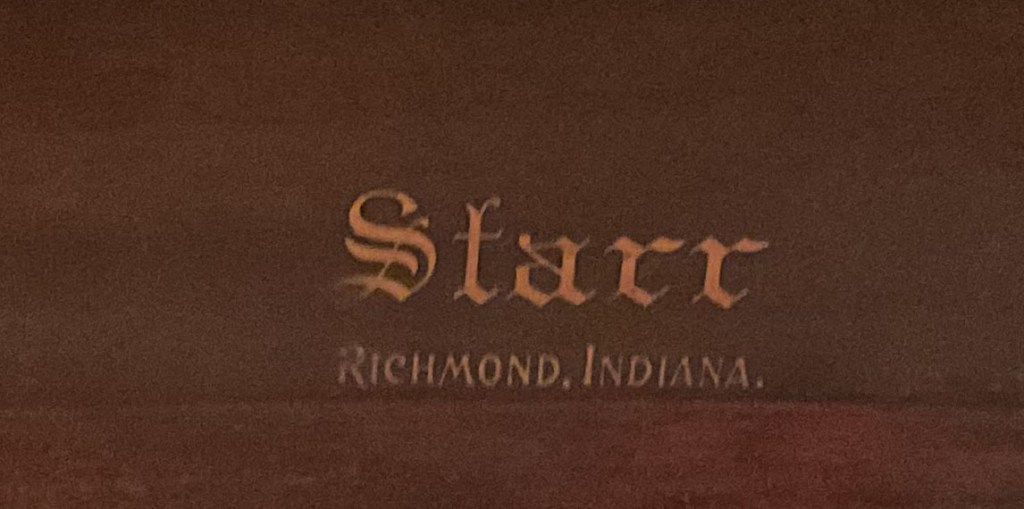
    Lifting the keyboard cover, I found this on the underside of the keyboard cover.

    Raymond’s Early Life

    Raymond Coursen, the first husband of Frances Cabell Coursen Perritt played this model and played it well. The baby grand didn’t come into Raymond’s and Frances’s lives until they had settled on Maui on the Hawaiian Islands.

    Raymond made piano music and sang long before he married Frances. This wasn’t even the first piano in Raymond’s life. A clipping, saved by Frances described Raymond as 7-year-old boy at a big recital with a black eye. He sang in his young soprano voice a solo- “Sleep, Little Tulip”.

    Edgar Coursen, his father, taught him to play the piano while he was a boy. Soon his legs were long enough to reach the petals. So then his father taught him how to play the organ. His mother Annie Griffin Coursen was the singer in the family. She sang opera on stage.

    Off To College

    Raymond entered Oregon Agricultural College (OAC) in 1912. He was a natural choice for a piano accompanist. He joined the Glee and Mandolin club at OAC. He performed piano solos at this club’s concerts as well as being the accompanist for the group.

    A Year in the Hawaiian Islands

    His expressive playing led to a job in his junior year.  In 1914, the Liberty theater of Honolulu hired Raymond to play the organ at their theater in Honolulu, Hawaii. The photo below shows the theater organ at the bottom middle. The films shown during this era were silent, so Raymond supplied sound by playing the organ. The Liberty theater also held live performances on stage. Raymond is playing on a grand piano in the back on the right.

    After playing for 8 months in the theater in Honolulu, he went on tour. He joined the Bervani Grand Opera Company. During the next month he did a tour of the islands. At the end of the tour, he went back to playing at the Liberty Theater.

    Back To Portland, Oregon

    Returning to Oregon but not to OAC, Raymond found a girl. He married Frances Cabell on September 16, 1916. Then he introduced his bribe to the Hawaiian Islands. They moved to Maui where Kula Sanitarium hired him as superintendent of outside work. After three years at the sanitarium, he was hired by the Hilo Sugar Company to work on their Wainaku farm. This farm was also on Maui. Both daughters were born on Maui Island- Rose in May of 1917 and Betty (Elizabeth) in December of 1918.

    The Baby Grand Piano

    The Coursens purchased their baby grand piano from the Starr Piano Company while they were in the islands. Since the Minum grand model was built in Richmond, Indiana, their piano’s first trip involved a long ocean voyage. But the Starr Piano Company shipped their products. From Richmond, Indiana to Maui it is about 4,300 miles. This trip was not the last ocean voyage the Coursen’s baby grand piano made.

    Return to the Mainland

    In the summer of 1923, the Raymond Coursen family returned the mainland of United States. They arrived aboard the SS Enterprise at the port of San Francisco on August 25, 1923. Among the items shipped for Raymond was his baby grand piano. The American and Foreign Marine Insurance Company insured this piano for 700 dollars. The piano was to travel from Hilo to Seattle, Washington, then on to Portland. I assume the insurance was for damage at sea. From there the piano went to 658 Lovejoy St., Portland, Oregon where Raymond’s Mother and father lived. The young Coursen family visited with the elder Coursen family for a while.

    To Bend Oregon

    Four years later, the family moved to a ranch in the Tumalo project, located near Bend, Oregon.

    Edgar Coursen visited them there sometime in 1927 and writes to Frances in September of 1927.

    “There is one thing sure and that the kiddies (Rose and Betty) are getting a good, rugged, healthy start in life that will stay with them for good. And I want to congratulate you Frances on the beautiful way that the children are being brought up.”

    In another letter Grandfather Coursen asks after the horses, cows, dog, cats and chickens at their Tumalo home. Apparently, Edgar Coursen regarded this venture as wilderness farming. But they did have the baby grand piano to play in Tumalo. Raymond taught both girls to play.

    In July, 1928, Raymond started working for the Brooks-Scanlon Lumber Company of Bend. He worked there until his death in 1933. In Bend, the Coursens lived first at 125 Revene Avenue and then at 316 Delaware Street. Raymond studied small engines on the job and by correspondence. On September 14, 1932 he was proclaimed proficient in these topics. He had studied machines, electricity and refrigeration.He was awarded certification stating this from the International Correspondence Schools in Scranton, Pennsylvania. 

    A Sad Event

    About one year later Raymond died in Portland, Oregon after surgery for bladder tumors. He had a severe reaction to the nupercaine spinal anesthesia used during the surgery. Raymond died 22 June 1933. He was sorely missed by his family and Bend friends. Frances and the girls moved to Portland later that summer.

    The baby grand was moved back to Portland. This time Frances and the girls moved in with her mother, Bessie Goughler, and Bessie Husband Mac. Bessie and Mac’s house at 3415 N.E. 47th Ave. was big enough to house them all, even the piano.

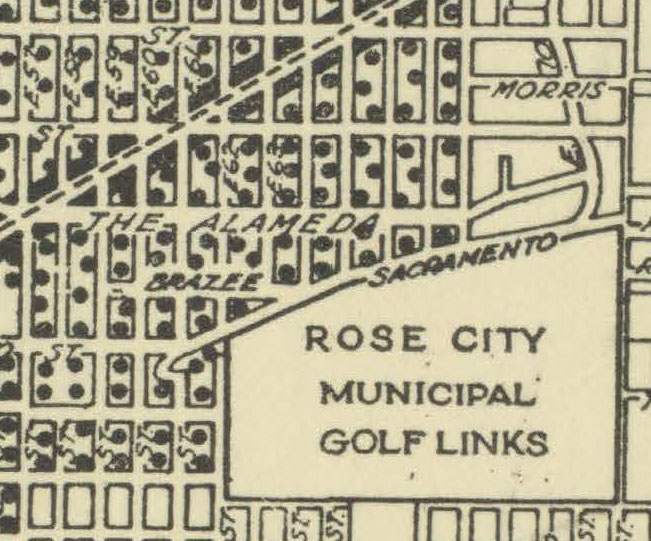
    Frances worked and saved until she became a home owner herself. She bought a house at 6305 Brazee Street in Rose City.They moved in on January 18, 1936. Their piano moved with them. But this wasn’t the piano last home.

    The daughters married in 1940. Rose married Howard Foster on June 30 1940. Betty married Bud Robert “Bud” Miller on August 30, 1940.

    Frances Marries Again

    Frances married Hayes Marion Perritt on April 12 1942. They bought property on the Oregon coast near Lincoln City. This place was so remote that electrical and telephone service was not available.

    It must have been a struggle to move the baby grand piano up the steep gravel and grass road. But it happened. Frances played the piano at night by lantern light. The piano sat in the Perritt’s beach house for more than 40 years.

    When this couple separated, Frances moved to a small apartment in Beaverton, Oregon. It filled half the largest room. Visitors squeezed around it. Frances died on May 20, 1994.

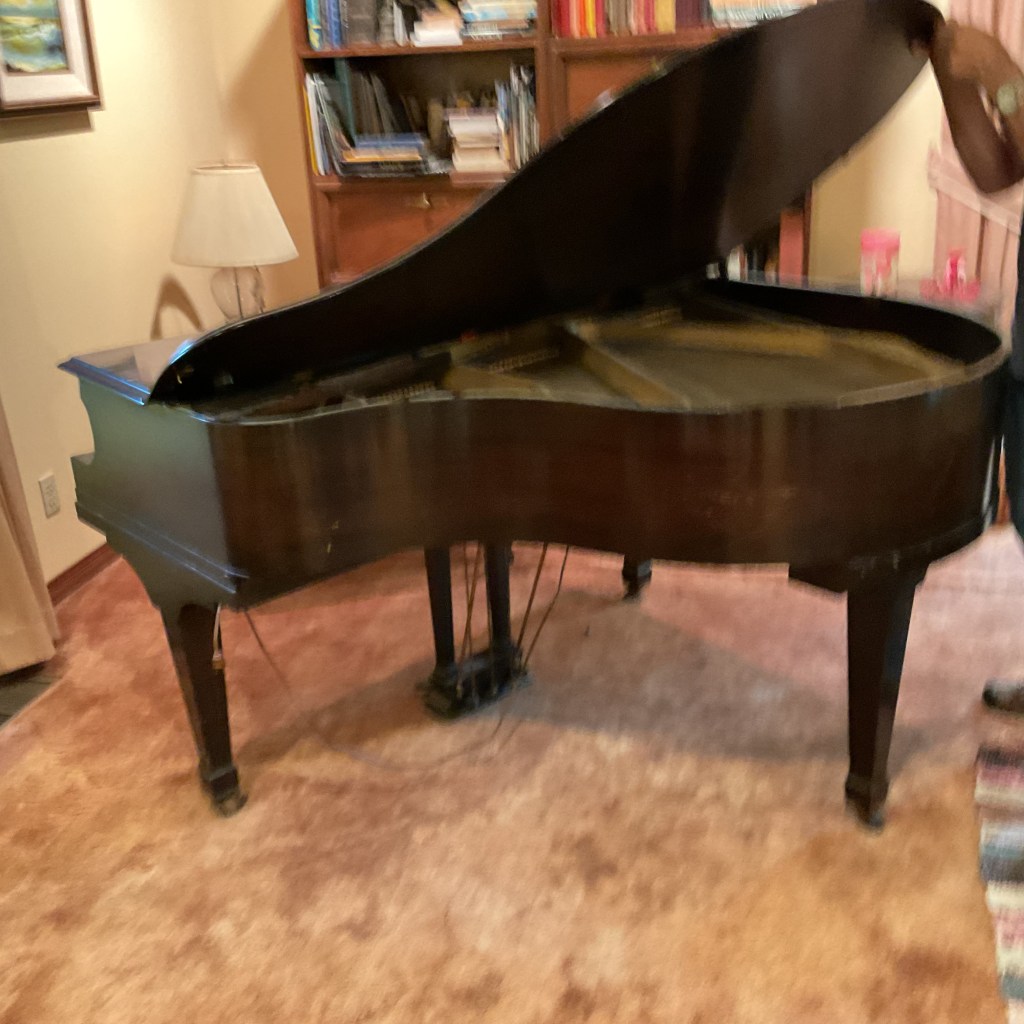
    The piano went to a grandson’s home and is still there. It had been new more than 100 years ago.

    Here is a photo.

  • James Crowley-Encounters with the Law

    James Riley Crowley is a 3rd Great Uncle to my husband. I wrote a biography about James a few years ago. The biography is on Wiki under James Crowley.

    I want to share a part of this biography that tells about three of James’s experiences with the law. He had three such experiences in the space of eleven years.

    James migrated from Ray County, Missouri to Polk County, Oregon with his parents 1864. Here in Oregon, he married, started a family and acquired land. He first owned a farm in Perrydale, Polk County. Secondly, he owned land on Cascade Head, Tillamook County.

    In June of 1882, his troubling times in Oregon courts began. James didn’t see the murder. He heard the gun shots and found the body.

    The Nathan Nott Case

    The first trial involved James’s hired hand who lived with the Crowleys. James was a key witness at two of these trials. In the first trial Nathan Nott, James’s hired hand, was tried for the murder of William Frakes.

    The 1880 census for Salt Lake District, Polk, Oregon shows these people living in dwelling #132 with James R. Crowley, age 37. They are his wife, Martha C., age 31, his daughter Mary J., age 10, and two sons, Walter, age 3, and James R. (Ralph), age 1. Also, living here was a single farm worker from Illinois named Nathan L. Nott, age 30.

    A disturbing news item from the Corvallis Gazette went to print on June 9, 1882. This article featured Crowley’s boarder, one, N. L. Nott.

    Hired Hand commits a murder- Nott trial 

    On Tuesday evening last week, William Frakes, an old resident of this county, was murdered at Bear Camp, on the Salmon River Road, by N.L. Nott, says the Dallas Itemizer. From the information we have been able to obtain it seems that Nott had formerly been keeping some stock for Mrs. Frakes on the shares and some misunderstanding arose regarding the matter. On Sunday last Mr. Frakes started from home to bring back a cow and calf, which had been in Nott’s possession, and which had been left on the range. On Tuesday Nott, James Crowley and Billy McKinney started from Salt Creek with some stock which they were taking to Salmon River. They met Frakes at the place where he was murdered, and it is said that Nott remarked to McKinney that he had a job to attend to, and left him and in a few minutes, shots were heard and Nott came back, announcing that he had killed Frakes

    “Murder”, The Corvallis Gazette, (Corvallis, OR), 9 Jun 1882, p.3, col 1, (https://oregonnews.uoregon.edu/lccn/sn84022650/1882-06-09/ed-1/seq-3/

    A second article printed on June 10, 1882, in the Eugene Guardian continued the story saying,

    A Murderer Under Arrest 

    McKinney was then sent to the house of Mr. Mulligan, about a mile distant, and when he arrived at the camp Crowley and Nott had eaten their supper and were there; Mr. Mulligan was requested to take the body to Perrydale, which he consented to do, and on Wednesday he brought the remains to the place named. Nott, Crowley and McKinney proceeded on their way to Salmon River. John Crowley started after them on Wednesday, and Nott was met by Sheriff Hall at Grand Ronde on Thursday. He claimed he had acted in self- defense and was coming back to give himself up. He was brought to Perrydale, and his examination postponed until Wednesday next. He is now in jail at this place. Frakes received four shots, one in the breast proving fatal. Both arms were broken and he was shot through the thigh It is supposed he was on his horse when shot.

    “A murderer Under Arrest”, Eugene City Guardian (Eugene, Oregon), June 10, 1882, p 5, col. 2 near top (https://oregonnews.uoregon.edu/lccn/sn84022653/1882-06-10/ed-1/seq-5/#words=Frake+Frakes+Nott
    • On July 29, 1882 Nott was on trial for killing William Frakes as the Polk County Itemizer went to print.
    • Two weeks later the Polk County Itemizer reported that Nott had been found guilty of murder in the second degree.

    Naoma Shelton vs John L Shelton

    James’s younger sister, Naoma Crowley, was born when James was 17. On October 25, 1880 Naoma married John Lawrence Shelton at the home of John’s mother. They had four boys. When Naoma was 32 years-old, she filed for divorce.

    James and John had known each since 1873. Both were farmers living in the vicinity of Dallas, Oregon. Naoma met John much later.

    In April of 1891 James rescued his younger sister, Naoma Crowley Shelton, from a house in Portland, Multnomah, Oregon. In Portland she lived with her four boys and her abusive husband, John Lawrence Shelton. James took her and her sons to his home near Dallas, Oregon. She filed for divorce on April 10, 1891. The case came to court on May 10, 1892. Naoma was 32 and still living in Dallas, as did James Crowley.

    James said in his testimony he had known John L. Shelton for 18 years and Naoma all her life. He also said that John had ran through Naoma’s property. She had owned 400 acres of land when they married. John drank and gambled it away. Here is a partial transcript of James’s testimony:

    James’s Testimony

     She wrote me that he was treating her so badly that she could not live with him, so I went and brought her to Dallas. At that time, they were living in Multnomah County. He accused her of being intimate with other men in my presence. When I went after her, she told me that he had been abusing her, that she couldn’t live with him and was afraid to do so. When I went after her, I found her and her children almost destitute of clothing. On a number of occasions, I heard him use abusive language toward her. After she came to my house, he came there drunk and used such abusive language towards her that on two or three different times, I was compelled to put him out of the house.

    Circuit Court of the State of Oregon, Polk County, Divorce Record, Naomi Shelton vs John Shelton, Record # 16009, Case #2247, Oregon State Archives, Salem Oregon, in the files of Jill Foster

    Here is a copy of the last page of James’s testimony with his signature.

    Bowker’s Trial

    James’s next exposure to Oregon’s legal system came in the summer of 1893. The court at Dallas, Oregon subpoenaed him and his sister Naoma Shelton as witnesses at the Bowker’s Trial.

    Charles A. Bowker, who worked the Southern Pacific railroads at the time of his arrest, had been a Baptist preacher. Charles had delivered services at the Baptist Church in Dallas attended by the Crowleys. When he was preaching in Dallas he was respected and well-liked.

    Charles was the fireman on the evening train running between McMinnville and Portland. He was arrested and tried for manslaughter in Portland. It seems he got a young woman pregnant, a seventeen-year-old named Helen Wilson. This happened in Portland, Oregon. Charles was charged with having arranged the abortion which killed Helen.

    In this first trial Charles was acquitted. But, more trials were conducted and he was charged and spent time in prison. In November of 1894, he secured a new trial, and he was released on bail. This case eventually went to the Oregon Supreme Court. The Oregon Supreme Court reversed Charles’s conviction and he was acquitted.

    More Troubles

    It would seem that these three court cases would be enough for one man to bear. But in 1893, James’s wife died.

    The announcement of Martha’s death was made in several Oregon newspapers. She died of cancer at her Dallas home on Tuesday, June 13, 1893. The family buried her at Crowley, Oregon in the Oak Grove Cemetery (Etna Cemetery) on Thursday, June 22 1893.

  • Water and Steamboats

    Part 3 of the Daniel Ferguson Story

    Frances Perritt, my husband grandmother, saved a clipping of her grandmother’s obituary. Her Grandmother, Margaret St John Ferguson Reynolds, was Daniel’s daughter. The part in the obituary about Daniel reads:
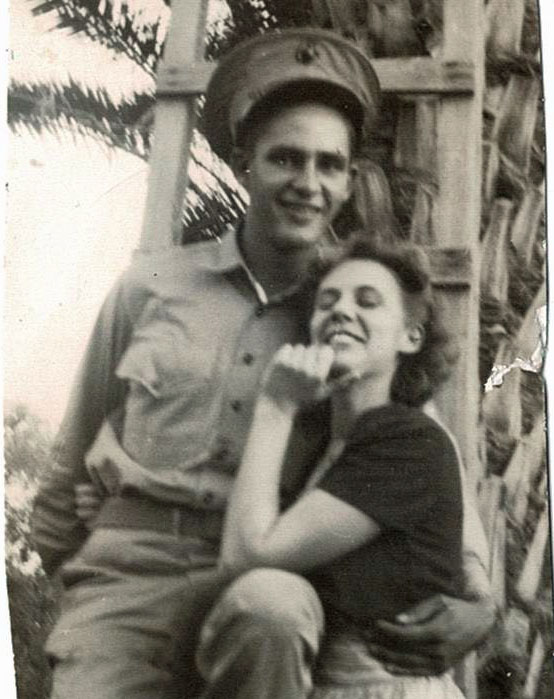
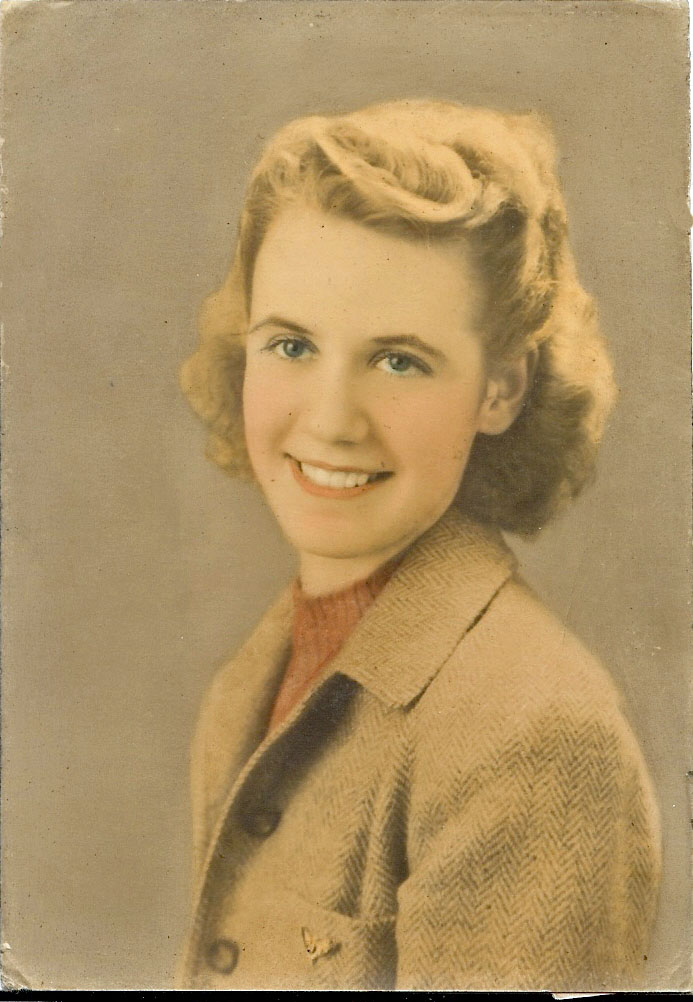
    Her father Daniel H Ferguson was a mill man and steamboat owner. In the early days and at one time he owned the dam where Oregon City locks are now located.

    The obituary of Louis P. Reynolds reads that “he was the grandson of the late Daniel H. Ferguson who was one of the principal owners of the Willamette Falls Canal and Milling Co. of Oregon City, in 1852 to 1853.”

    In my search for the owner of Willamette Falls Canal and Milling Co., I found several articles about Robert Moore saying he was the owner of this company. Then after much searching, I found a newspaper article In the Oregon Argus, dated August 21, 1858. This article explained the ownership of this company. But first a little background would be appropriate.

    Before Daniel bringing his family to Willamette Valley, he prospected for gold on the Yuba River in northern California. He and his brother, Thomas, had other business besides gold mining. One was investing in fast growing towns. Thomas wrote in a letter to his wife in Florida in April of 1850. He said “I have invested in Lindd <sic> City (Linn City, Oregon) one thousand dollars.”

    Daniel and Thomas were in business together. They referred to themselves as Ferguson & Ferguson or the Ferguson Brothers.

    So, Daniel had some dealings with Linn City a couple of years before his arrival in Oregon.

    The Main Water Ways of Oregon

    Before railroads came to the Willamette Valley, travel by steamboat was the main way to get between Astoria and Marysville. Shipping on the upper and lower Willamette was a profitable enterprise.

    Two river dominated Daniel’s life after he moved with his family to Oregon—the Columbia and the Willamette. The Columbia River separated Washington Territory from Oregon Territory when Washington Territory was established on March 2, 1853.

    The Willamette River flows through the Willamette Valley north from Eugene. The upper tributaries of the Willamette originate in the mountains outside Eugene.  On its way north to the Columbia River this river flows through the many Oregon towns. Some of these towns along the upper Willamette are Eugene, Corvallis, Albany, Salem, Newburg, Wilsonville, Oregon City, and Portland. It empties into the Columbia River at Kelley Point, Portland, Oregon. It is the 13th largest river by volume in the United States. The Willamette Falls is located between West Linn and Oregon city. It is the second largest waterfall by volume of water in the U.S.

    This large waterfall was an obstacle to steamboat travel on the Willamette River between the upper and lower river.

    Photograph of Willamette Falls in Oregon City, Oregon, from California Historic Society and USC

    Grass crops like wheat and rye did well in the upper Willamette Valley. The excess crops needed to be transported down the Willamette to Portland and beyond.

    Ideally transporting these excess crops on the river would solve the problem. The typical steamship was large and deep keeled. It couldn’t maneuver in the shallow water of the upper river beyond Oregon City. The Lot Whitcomb, built in Milwaukie, Oregon in 1850, ran on the lower Willamette. She traveled between Milwaukie and Astoria. Daniel planned to enter this new industry with boats designed for the shallower upper river waters. Getting the right design of steamboat was not the only problem.

    The other problem was getting the goods from the upper river to the lower river.  There was a 35 feet drop over Willamette Falls at Oregon City. A portage road around the falls existed at this time.

    Robert Moore’s Linn City

    Donation Land Claim Map 1852 Linn City and Oregon City from West Linn Historical Society

    Robert Moore’s Linn City (West Linn) was situated on the west bank of the Willamette River. Oregon City on the east side was directly across the river. In 1846, Linn City consisted of about 15 houses occupied by mechanics employed by Moore. They worked in his flour and lumber mills. His employees also ran a ferry which crossed the river to Oregon City. Moore also owned Willamette Falls, Canal, Milling and Transportation Company and a newspaper, The Spectator.

    Daniel Ferguson in Linn City

    When the Ferguson family came to Portland, they soon acquired a home there. Their house stood on 2nd Street, one door down north of Mill Street. It was close to the Willamette River. Soon after they were settled in Portland, Daniel started traveling upriver to Linn City. By 1853 Daniel even had living quarters on the hillside overlooking Linn City. Robert Moore lived nearby. By the time, this man was tremendously overweight, unhealthy and had debts.

    In December 1852, Robert Moore transferred the title and the land of this company to Daniel. Robert gained some capital and a promissory note. Daniel acquired a ten-year mortgage. Daniel was now the owner of the Willamette Falls, Canal, Milling and Transportation Company. He also owned the land where the Oregon City Locks are now located. Daniel’s ownership of these properties lasted only a few months.

     In January, 1853, he asked the provincial government of the Oregon territory for permission to incorporate this business. Then in March of that year he transferred the title and the debt to this new corporation. People referred to this company as the Willamette Falls Company, the Willamette Falls Canal Company, D. Ferguson Company and Messrs., Ferguson and Company.

    Daniel’s Building Projects at Canemah

    In June of 1853 Daniel ran this ad in The Weekly Oregonian.

    Wanted Immediately

    Twelve good drillers and blasters; Fifty good common labors, person used to quarrying and working rock; Six good carpenters, such as are used to working timber; Three good hands used to boating and rafting timber; Also One good blacksmith, one that is competent to do all kinds of black smith work.

    Constant employment and good wages will be given to such by applying to the office of the Willamette Falls Canal Company.

    Daniel H. Ferguson         Superintendent

    “Wanted Immediately,” Weekly Oregonian (Portland, Oregon) 2 July 1853, p.3; digital images, GenealogyBank (http//:www.genealogybank.com

    Daniel wanted to build a breakwater. His men would dig a basin big enough to accommodate a steamboat while loading and unloading cargo. This work would be carried out at Canemah. Canemah was at the southern end of portage around Willamette Falls. It was used by native Americans as a takeout place for canoes before carrying the canoes around the falls. Here boat traffic from the upper Willamette River stopped. People and goods were unloaded and taken around the falls to Oregon City around the falls. Then they were loaded into another boat.

    Before Daniel left Canemah he and his men had built a sawmill, gristmill a warehouse, and a wharf.

    In August of 1853 Daniel Ferguson is praised by the editor of the Oregon Spectator. The article reads.

    At Canemah, within the past twelve months…Our neighbor too, Linn City is not behind in enterprise and good works. Under the energetic management of D. Ferguson and Company, a fine breakwater and dam are rapidly advancing to completion. Mills and warehouses are now framed and soon to be erected, all calculated to give unsurpassed facilities for transportation of merchandise above and below the falls together with magnificent water power which could drive all the mills of Lowell and Rochester combined. The work is built so far as we can judge, in the most durable and permanent manner, with great strength and on a judicious plan. Nature has done wonders for the locality, and Messrs., Ferguson and Co. are most ably seconding her labors.

    “Improvement,” Oregon Spectator, (Oregon City, Oregon) 26 August 1853, p.2 col 2; digital images; Historic Oregon Newspapers,(http://oregonnews.edu

    In the January 7th 1854, the editor of the Spectator again praises Daniel’s work in Linn City. The editor describes the breakwater Daniel is having built. The editor also describes a device Daniel is having built that will make unloading and loading the boats much easier.

    The plan is admirable, and no giant power of water could have been more completely controlled and managed. The breakwater is some thirty rods cast from, and running parallel with the west bluff of the river, and continues near one-fourth of a mile up the river from the perpendicular falls, so that by a connection of the west bluff with the breakwater by a dam passing along near the brink of the precipice, the various designs and objects in view of water into are fully accomplished, viz: the reception of water into the harbor for the admission of steamers, and for the purpose of driving their and extensive saw and flouring mills and enable them  to exchange the lading from boats above and below the falls, loaded with the various products of the upper country, and those below laden with  goods, can come together and have their freight discharged by a timber built into cribs, which  are piled with stone and sufficiently covered with plank. The works are placed upon the solid rock and are as lasting and durable as the very hills. Ferguson and Co. are much applauded for the undertaking of that which seemed almost impossible…

    “For the Spectator,” Oregon Spectator, (Oregon City, Oregon) 7 January 1854, p.2 col 3; digital images; Historic Oregon Newspapers,(http://oregonnews.edu

    The Steamboats

    In 1851, the only way boating on the upper Willamette was by canoe. The trip to Salem and Marysville (Corvallis) was long, tiring and not practical for transporting goods.

    In 1853, four steamboats operated out of Canemah. They were the Oregon, the Wallamet, the Portland and the Belle. Daniel’s Willamette Falls Company, owned the Belle and the Oregon. In April 1854 ,Daniel planned to launch another steamboat that was being built at Canemah. This steamboat, the Gazelle, would run on the upper river between Marysville and Canemah.

    The Belle, which was already in service ran on the lower river. With the launch of the Gazelle the company would have three steamboats on the Willamette River.

    On March 4, 1854, Daniel puts this ad in the Weekly Oregonian.

    Notice to the Public

    The Willamette Falls Co. is now ready to receive and forward all kinds of merchandise, through their new warehouse, up and down the river. The steamer Belle, Capt. Wells, is running from Portland to the falls in connection with the steamer Oregon from our new warehouse to the head of navigation on the upper Willamette.

    The new steamer Gazelle, under the command of Capt. R. Hereford, will be ready to run in a few days.

    Charge for passing freight over the fall is $1 per ton.

    Passengers will be conveyed to and from Oregon City at all times with dispatch.

    D. H. FERGUSON, Superintendent

    Notice to the Public,” Weekly Oregonian, (Portland, Oregon) 4March 1854, p.5 Col. 1, digital images, GenealogyBank.com,  (http://www.genealogybank.com

    On March 11, 1854, Daniel puts this ad in the Weekly Oregonian.

    On March 18, 1854 the Gazelle made her first run on the upper Willamette with Capt. Robert Hereford at the helm.  A local newspaper had this to say about the run.

    The fine weather and good music tended not a little to enhance the pleasure of the ladies and gentlemen on board, and all were highly entertained and pleased. Her tables are laden with Oregon’s choicest productions, together with a select variety of imported fruit, etc. Who wishes for better accommodations, even in this Tyee day of Oregon refinement?

    “Gazelle (sidewheeler,1854)”, Wikipedia, Sept. 1, 2011, (http://en.wikipedia.org:

    In this description of the Gazelle’s first trip on the upper Willamette, the editor uses the term “Typee day. The term, “Typee day”, comes from a novel by Herman Melville called Typee and published in 1846. It means a relaxed and unhurried day. This is a high point in Daniel’s life’s work and is about to change. It would be a long time before Daniel had a Typee day again.

  • A City Girl

    Week 43 Urban, Part 2 of the Daniel H. Ferguson Story

    Jeannette Keeler was a city girl. She was born on July 16, 1816, to Abraham Keller and Sarah Dann Keeler. Their town, Danbury, Connecticut, was a growing town of 3.5 thousand people and a thriving industry. The people of Danbury made hats.

    I found a small item from Jeannette’s life in the scrapbook I inherited from my husband’s grandmother, Frances Perritt. Jeannette was my husband’s 3rd great grandmother. This item was a small white card rimmed in black and inscribed, Mrs. D. H. Ferguson. Calling cards or visiting cards, popular across America throughout the 1800s. Ladies carried in small purses when making their social calls to family and friends. They left cards at each house they visited. They usually left three cards- one for the master and two for the mistress. The host often displayed these cards on a small table in the front hall. The card of the most high-ranking caller was on top. A black-edged card meant the caller was in mourning.

    Jeannette Keeler married Daniel Howes Ferguson on June 21, 1838, in Danbury, Fairfield, Connecticut. The wedding was a home wedding. J. G. Collum officiated. The young couple settled in Norwalk- a settlement on the northern shore of Long Island Sound. Their five children were all born here in Norwalk, Fairfield County, Connecticut. Their youngest two, both James and Margaret, told census takers they were born in New York. By this they meant the New York metropolitan area which included the city and suburbs of New York City. Long Island where Norwalk, Connecticut is located is in this metropolitan area as well as parts of New Jersey and Pennsylvania.

    Jeannette and Daniel were the parents of five children born in Norwalk. The Ferguson Family Bible lists births of him, his wife, and children.

    Daniel H. Ferguson was born March 18, 1816.

    Jennette Keeler was born July (illegible),1816.

    Elbreannah Ferguson was born May 2, 1839.

    Frances Anne Ferguson was born April 17, 1841.

    Elbert Frances Ferguson was born May 21, 1843.

    James F. Ferguson Aug. 16, 1845.

    Margaret St. John Ferguson Oct. 24, 1847

    In the summer of 1842, Jeannette Ferguson had black-edged cards printed. The cards said Mrs. D.H. Ferguson. She had much to mourn. On June 16, 1842, her first child, a daughter, Elbreannah died. Less than a month later, July 8, 1842, Frances Anne died. Jeannette and Daniel buried their girls in Danbury at the Wooster Street Cemetery in the graveyard behind the jail.

    Shortly after their last child, Margaret St. John, was born the Fergusons moved from Norwalk to Danbury. The people of Danbury still made hats.

    Danbury was the “town to be in” if you were in the hatting business in 1840. In 1820 there were twenty-eight hat factories in Danbury. The raw materials needed to make beaver skin top hats grew in the woods and rivers nearby. The beavers lived in the streams. Woodmen cut trees for wood. Workers used water power from the rivers to drive the machinery. Making beaver fur into hats requires heat, moisture and pressure to felt the fur. Then hatters shaped the felt into hats. By 1831 the number of people involved in the hatting business surpassed the number in all the other Danbury businesses put together. By mid-1840s the hatting business became mechanized. Hatter manufactured more hats in Danbury than anywhere in the United States. Danbury was known as Hat City.

    While Daniel sought gold in California, Daniel’s family lived with Jeannette’s younger sister, Marietta Keeler Hyatt, her husband, Alfred Hyatt. Alfred, head of his household, was a hatter. Marietta and Alfred had two boys, Edward and Wallace. The 1850 federal census lists these eight people living in one housing unit, dwelling number 642. Alfred Hyatt is listed as head of family 754 and Jeannette (Jeannette), age 32 is head of family 755. Her three children are- Elbert, age 8, James, age 5 and Maryetta (Margaret), age 3. James and Elbert attend school.

    Here is a photo copy of this 1850 record from Danbury

    Daniel Ferguson Make an Entrance

    Jeannette worried that Daniel had not arrived home by Christmas as planned, but he did get there before 1850 ended.

    He arrived in Norwalk harbor aboard the SS Ohio with Captain Schenck at the helm. Daniel had hoped to reach home before Christmas; the Ohio had just departed from Havana on December 18th on time. Shortly out of the Havana harbor one of her engines blew out so she returned to Havana for repairs. She resumed her trip on the 19th making good headway until the 22nd of December when a gale hit. Having only partial power she sat out this storm; then shortly after getting underway she sprung a leak. Passengers and crew alike bailed water out a little faster than it came in. The Ohio reached the wharf at Norwalk on December 26, 1850.

    To Oregon

    Did Jeannette want to travel thousands of miles to the west coast? It would be a hard trip with three children. Her youngest, Margaret, was only four. But Daniel did convince his wife to go west with him.

    The next time Daniel traveled his family came with him. His family included Daniel himself, Jeannette, Elbert, James and Margaret. They traveled the same route as Daniel had. This time Daniel was a rich man and who bought the nicer lodgings in comfortable ship quarters. There were goodbyes to be said, items to buy and letters to write. The boys finished a term at school. Also, they needed to consider the best season to cross the Isthmus of Panama. Cholera, although always a risk, was at epidemic proportions in the rainy season. On the first leg of their journey, they traveled by boat from New York to Chagres. The second leg across the Isthmus started at Chagres where they boarded flat-bottomed boats. Men pushed the boats up the Chagres River with poles to Gorgona. After Gorgona they rode mules to Panama City. Alligators, monkeys, parrots, and mosquitoes buzzed, hummed, screamed, and showed their teeth. Yellow fever, cholera, and malaria still sickened travelers. They were brave to come, and they survived the crossing of the Isthmus. The trip from Panama City to San Francisco was tame compared to crossing the Isthmus. But it was long and usually took two months by boat. When they reached San Francisco, they visited places and people Daniel knew. They arrived in Portland, Oregon sometime in 1852. They finished the ocean voyage part of their trip at Astoria as their destination was Portland, Oregon, USA. The Columbia River enters the sea at Astoria; canoes and small river steamboats took travelers on to Portland. In that year according to Claude-Alain Saby, Portland’s population was about 4000 people. 

    Elbert Ferguson, who about 10 when the family arrived, died on December 9, 1863. Quite a while before this event, the Fergusons had established friends and a residence in Portland on 2nd Street. Here is a copy of the newspaper notice.

    Daniel, being restless and enterprising, would convince Jeannette to go with him many more times. In the end she outlived him. Here is her obituary.

    This obituary, published in The Morning Oregonian on April 20, 1984, has some mistakes. Bible records put Jeannette birth in July of 1816. The family came to Portland, Oregon and built a house before moving to Oregon City. Daniel lived in Oregon City alone in 1853. He is recorded in both the 1853 Oregon Territorial census and the 1857 census. The 1853 census recorded him as living alone in Oregon City. In the 1857 record, he is shown with his family. So Jeannette was living in Oregon City by 1858. It looks like whoever wrote the obituary switched the 1853 and 1858 dates.

    Why Jeannette moved to Oregon City

    Soon after the Fergusons set up housekeeping in Portland, Daniel started traveling to Oregon City. Oregon City is located 12 miles up the river from Portland. Two steamboats took passengers between Oregon City and Portland. One, the Portland, was a side wheeler. The other, the Multnomah, was a stern wheeler. The Multnomah ran every day except Sunday. The Portland ran a couple times a week. On July 2, 1857 the Multnomah fell over the falls at Oregon City putting her out of the picture.

    Jeannette wanted to see her husband more than twice a week. She and the children moved to Oregon City as shown in the 1857 Oregon Territorial census.

    Another Piece of this Story to Come

    The next piece is about Daniel’s project in Oregon City and a fatal fire. Another piece of Daniel Ferguson life is included in Traveling by Mail Boat.